

How Color Temperature and CRI in Retail Lighting Influence Buying Decisions
Color temperature CRI retail lighting decisions affect your bottom line more than most store owners realize. Two stores can stock identical products, price them the same, and still see a 20-40% gap in sales — and the difference often comes down to what's hangi
On this page
Color temperature CRI retail lighting decisions affect your bottom line more than most store owners realize. Two stores can stock identical products, price them the same, and still see a 20-40% gap in sales — and the difference often comes down to what’s hanging from the ceiling. The light that hits your merchandise changes how customers perceive quality, freshness, and value.
This guide breaks down exactly how correlated color temperature (CCT) and color rendering index (CRI) work together to influence what shoppers buy, how long they stay, and whether they come back. We’ll cover the science, the research data, and a department-by-department specification chart you can use the next time you spec a lighting retrofit.
What Is Color Temperature (CCT) and Why Retailers Should Care
Color temperature measures the warmth or coolness of white light, expressed in Kelvin (K). Lower numbers mean warmer, more amber-toned light. Higher numbers mean cooler, bluer light.
Here’s the practical range for retail:
- 2700K — Warm white. Think candlelight. Relaxed, intimate, golden.
- 3000K — Warm white. The standard for hospitality and residential spaces.
- 3500-4000K — Neutral white. Clean but not clinical. The workhorse of grocery retail.
- 5000K — Cool white. Bright, alert, task-oriented.
- 6500K — Daylight. Bluish-white. Mimics overcast sky.
Why does this matter in a store? Because CCT sets the emotional tone of a shopping environment. A jewelry counter lit at 2700K feels luxurious and exclusive. A produce section at the same temperature looks muddy. A deli at 6500K feels like a hospital cafeteria.
The US DOE notes that correlated color temperature is one of the first specifiers should select when designing retail lighting layouts, because it governs the mood of the entire space before CRI even enters the conversation.
For retail, warm light (2700-3000K) encourages browsing and impulse buying. Cool light (5000-6500K) keeps shoppers alert and focused — useful for electronics or pharmacy areas where customers need to read fine print.
Understanding CRI (Color Rendering Index) in Retail Environments
CRI — color rendering index — measures how accurately a light source reveals the true colors of objects compared to a natural reference source. The scale runs from 0 to 100. A CRI of 100 means perfect color accuracy, identical to natural daylight.
For retail decision-makers, here’s what the numbers mean in practice:
CRI 80 — The bare minimum. Acceptable for stockrooms, back offices, and general ambient lighting. Products under CRI 80 look acceptable but not appealing. Reds turn slightly brown. Blues look washed out. Skin tones appear sallow. Most budget LED fixtures ship at CRI 80.
CRI 90 — The US DOE recommendation as a retail baseline. Colors look natural. Most merchandise appears close to how it looks outdoors. Sufficient for general merchandise, hardware, and electronics departments.
CRI 95+ — The standard for color-critical retail. Fresh food looks genuinely fresh. Fabric colors render accurately under store lighting so customers don’t return items after seeing them in daylight. Cosmetics match skin tones properly. This is where high CRI lighting sales differences become measurable.
The practical gap between CRI 80 and CRI 95 is enormous. A tomato under CRI 80 LED light looks dull and slightly grey-brown. The same tomato under CRI 95+ at 3000K looks vibrant, red, and appetizing. The ASSIST guide to color in retail merchandising from the US lighting research consortium documents these differences across dozens of product categories.
CRI vs CCT: How These Two Metrics Work Together in Retail
Most retail lighting articles discuss CRI and CCT separately. That’s a mistake. These two metrics interact, and the combined effect on product appearance is not simply additive.
CCT sets the mood. CRI sets the accuracy. But the same CCT at different CRI levels produces visibly different results.
Take 4000K — a common grocery store specification. At CRI 80, 4000K light has spectral gaps that distort reds, greens, and skin tones. Products look “off” in ways customers can’t articulate but definitely feel. At CRI 95, that same 4000K fills in those spectral gaps. Colors render with full fidelity. The light feels natural, even though the CCT is identical.
This happens because CRI depends on the LED’s spectral power distribution — the full rainbow profile of wavelengths the chip emits. Two LEDs can share the same CCT rating but have completely different spectral shapes. One might spike heavily in blue and green while barely covering deep red. The other spreads energy evenly across the visible spectrum. Both read as “4000K” on a meter. Only one makes your products look right.
Decision framework for retail specifiers:
- If you’re lighting a space customers walk through (aisles, corridors): prioritize CCT for mood, CRI 85-90 is fine.
- If you’re lighting a product customers need to evaluate (meat counter, clothing rack, cosmetics wall): prioritize CRI 95+ and match CCT to the product type.
- If you’re lighting both ambient and task zones: use adjustable CCT fixtures so you can set different moods per area while maintaining consistent CRI 95+ across the board.
For a deeper comparison, see the CRI 90 vs CRI 95 buyer’s decision framework.
The R9 Value: Why CRI Alone Doesn’t Tell the Whole Story
Here’s something most retail lighting guides skip entirely: the standard CRI calculation (called Ra) averages only 8 color samples, and deep red isn’t one of them.
R9 measures how accurately a light source renders saturated red. It’s excluded from the standard CRI average, which means a fixture can advertise “CRI 90” while rendering reds poorly. A light with CRI 90 and R9 of 10 will make meat look brown-grey, strawberries look dull, and skin tones look lifeless.
Why R9 matters by department:
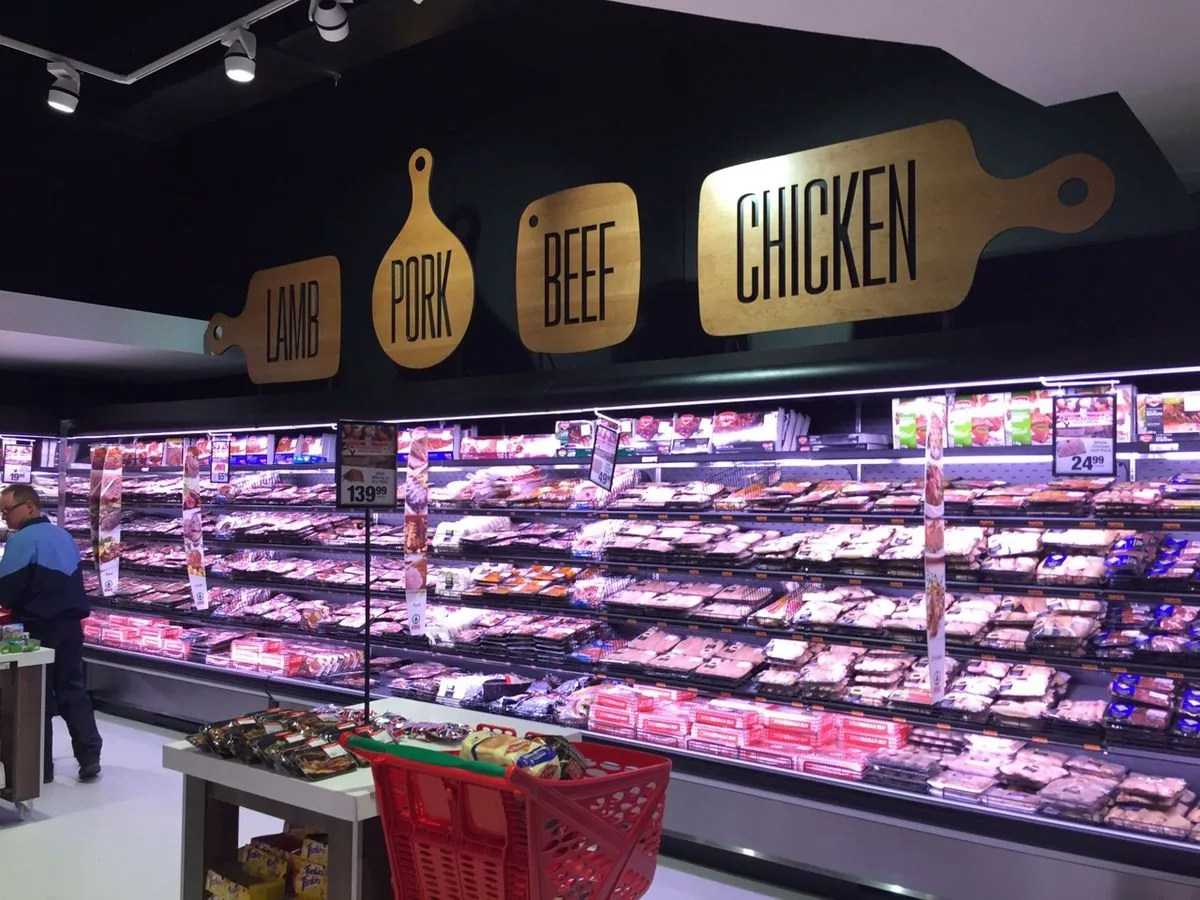
- Meat displays — R9 ≥ 80 is critical. Low R9 makes fresh red meat appear oxidized, brown, and unappetizing. The Penn State meat lighting best practices guide specifically addresses how spectral quality affects meat color perception.
- Bakery — R9 ≥ 50. Red tones in baked crusts, cinnamon rolls, and fruit pastries need accurate rendering to look warm and appealing.
- Produce — R9 ≥ 50. Tomatoes, peppers, berries, and red apples lose visual appeal under low-R9 light.
- Fashion — R9 ≥ 50. Red garments, burgundy, coral, and pink fabrics render inaccurately, leading to customer returns.
When you request quotes from lighting suppliers, ask for R9 data specifically. Many manufacturers omit it from spec sheets because their R9 numbers are poor. If a supplier can’t provide R9 values, that’s a red flag.
For fresh food departments where red rendering directly impacts sales, look at ARMOR fresh food CRI 95+ LED lighting with R9 ≥ 80 across the full fixture range.
Research: How Lighting Color Quality Influences Customer Buying Decisions
The link between lighting quality and sales isn’t theoretical. Multiple studies across retail environments show measurable, repeatable results.
Grocery Dive / KlikUSA — 2% purchase increase in LED-lit sections. In a split-store study, half the store used LED lighting while the other half kept fluorescent. The LED-lit sections saw a 2% increase in customer purchases. Two percent might sound modest — but on a grocery store’s annual revenue, that’s hundreds of thousands of dollars from a lighting swap.
Philips Lighting — 18% impulse purchase increase. Clothing stores that switched to warm color temperature lighting saw an 18% increase in impulse purchases. Warm white light creates a relaxed browsing atmosphere. Customers slow down, touch more products, and add unplanned items to their carts.
Colonial Park Plaza — 38% sales increase, 19% profit increase. The National Lighting Bureau documented a 38% sales increase and 19% profit increase at Colonial Park Plaza in Pennsylvania after a comprehensive lighting upgrade. The retrofit focused on both CCT and CRI improvements.
House of Fraser / Xicato — 2x purchase rate on illuminated end-caps. Illuminated end-cap displays achieved a purchase rate of 33.3% compared to 14.3% on non-illuminated displays. That’s more than double. The lighting used high-CRI, targeted color temperature fixtures aimed at the display merchandise.
US Energy Star / Wesco — 19% grocery sales increase. The US Energy Star program documented a 19% increase in grocery store sales following LED lighting upgrades. Better color rendering made products look fresher and more appealing across departments.
What these studies have in common: the sales gains didn’t come from brighter light. They came from better quality light — the right color temperature matched to the right products, with high CRI ensuring accurate color rendering. If you want to understand the LED shelf lighting energy cost and ROI analysis behind these upgrades, we break down the numbers in detail.
Color Temperature and CRI Guide by Retail Department
This is the section to bookmark. Every department in a retail store benefits from a specific combination of CCT, CRI, and R9. Using one generic spec across your entire floor plan means at least some of your departments are underperforming.
| Department | Recommended CCT | Recommended CRI | Minimum R9 | Why |
|---|---|---|---|---|
| Meat & Seafood | 2700-3000K | CRI 95+ | ≥ 80 | Warm tones enhance red appearance; high R9 prevents brown-grey discoloration |
| Produce | 3000-4000K | CRI 90+ | ≥ 50 | Natural greens and vibrant fruit colors; slightly cooler than meat for freshness |
| Bakery | 2700-3000K | CRI 95+ | ≥ 50 | Golden warm tones make crusts and pastries look fresh from the oven |
| Dairy | 4000K | CRI 90+ | — | Clean, cool white signals freshness and hygiene |
| Frozen Foods | 4000-5000K | CRI 85+ | — | Cool bright light reduces perceived warmth; clear visibility through freezer glass |
| Fashion / Apparel | 3000-4000K | CRI 95+ | ≥ 50 | Accurate fabric color rendering prevents post-purchase returns |
| Jewelry | 3500-4000K | CRI 95+ | — | Precise gem and metal color accuracy; neutral tone shows sparkle |
| Electronics | 4000-5000K | CRI 90+ | — | Clean modern look; cool white signals technology and precision |
| Cosmetics | 4000-5000K | CRI 95+ | ≥ 50 | Accurate skin tone rendering; customers test products expecting daylight accuracy |
| General Merchandise | 3500-4000K | CRI 90+ | — | Balanced neutral white for mixed product types |
For small retailers who can’t afford per-department fixtures, 3500K at CRI 90+ is the best single-spec compromise. But if you sell fresh food, fashion, or cosmetics, the upgrade to CRI 95+ with department-matched CCT pays for itself through reduced waste, fewer returns, and higher per-customer spend. The LED shelf lighting guide for small business covers budget-conscious approaches to this.
Psychology of Warm vs Cool Lighting in Stores
Lighting psychology is one of the most studied topics in retail atmospherics research. The findings are consistent across decades of studies.
Warm lighting (2700-3000K) slows shoppers down. Customers spend more time browsing, perceive products as higher quality, and are more likely to make impulse purchases. Warm light creates a sense of comfort and safety. It reduces the perception of time pressure. This is why upscale boutiques, jewelry stores, and bakeries default to warm CCTs.
Cool lighting (5000-6500K) speeds shoppers up. Customers move through spaces faster, feel more alert, and make more task-oriented decisions. Cool light suits environments where efficiency matters — pharmacies, electronics stores, warehouse-style retailers. It also conveys cleanliness and modernity.
Price perception shifts with CCT. Research shows customers associate warm lighting with premium products and are willing to pay 10-15% more for the same merchandise displayed under warm vs cool light. The “warm = premium” perception pattern is deeply ingrained. Luxury brands exploit this relentlessly.
Dwell time and impulse buying correlate directly with CCT. Warm lighting increases dwell time. Longer dwell time correlates with higher basket value. The Philips study showing 18% more impulse purchases under warm lighting confirms this mechanism — customers linger, browse more shelves, and add items they hadn’t planned to buy.
Smart retailers mix CCT zones within a single store. The produce section runs 3000-4000K. The meat counter runs 2700-3000K. The dairy cooler runs 4000K. Each zone creates a micro-atmosphere tuned to the products in that area. This zoned approach is one of the most effective strategies for increasing per-department revenue without changing your product assortment.
How to Choose the Right CRI and Color Temperature for Your Store
Choosing color temperature CRI retail lighting specs doesn’t require an engineering degree. Follow this framework:
Step 1: Map your departments. List every distinct zone in your store — meat counter, produce section, bakery, dairy, apparel, checkout, etc.
Step 2: Look up each department in the table above. Note the recommended CCT, CRI, and R9 for each zone.
Step 3: Decide on fixed vs adjustable CCT. If your store layout changes seasonally or you’re uncertain about the ideal CCT, adjustable fixtures (2700K-6500K range) let you dial in the right temperature without replacing hardware.
Step 4: Request samples. Never spec a full store lighting retrofit from datasheets alone. Get sample fixtures, install them in your actual space, and evaluate them with your actual merchandise. Look at how products appear from customer eye-level, not from overhead.
Step 5: Verify R9 data. Ask every lighting supplier for R9 values alongside CRI. If they can’t provide R9, their CRI numbers may be misleading.
Common mistakes to avoid:
- Relying on CRI alone without checking R9. A fixture with CRI 90 and R9 of 5 will disappoint you in meat and produce.
- Using 6500K daylight across an entire store. It looks clinical and drives customers out faster.
- Assuming “brighter is better.” Lux levels matter, but quality (CRI + CCT) matters more than quantity (brightness).
- Ignoring the interaction between CCT and CRI. These specs must be evaluated together.
The industry is also moving toward TM-30, a newer metric that evaluates color fidelity (Rf) and color gamut (Rg) using 99 color samples instead of CRI’s 8. TM-30 provides a more complete picture of how a light source renders colors. If your suppliers offer TM-30 data, use it — it’s a more reliable predictor of real-world color quality than CRI alone.
For smaller stores working within a budget, the LED shelf lighting guide for small business walks through cost-effective approaches to high-quality lighting without overspending.
ARMOR CRI 95+ Retail Lighting Solutions
ARMOR manufactures CRI 95+ LED retail lighting with adjustable CCT from 2700K to 6500K — covering every department specification in the table above from a single product line.
What sets ARMOR apart for retail lighting buyers:
- CRI 95+ with R9 ≥ 80 across the full fixture range. Not a premium tier — the standard line. Red rendering is built in, not bolted on.
- Adjustable CCT 2700K-6500K. Set the exact color temperature your department needs without swapping fixtures. Change it later if your merchandising layout changes.
- Magnetic tool-free installation. LED rigid bars and shelf lights snap into place. No electrician required for standard installs. Stores deploy across hundreds of fixtures in days, not weeks.
- Fresh food specific solutions. ARMOR fresh food CRI 95+ LED lighting for meat, bakery, produce, and deli counters. Built for the exact CCT and R9 values these departments require.
- Custom display configurations. Every store has different fixtures, shelf depths, and ceiling heights. ARMOR builds retail display lighting customization solutions to match your exact installation requirements.
- ISO-certified manufacturing. ARMOR products ship to 50+ countries with full quality documentation, LM-80 test reports, and IES photometric files.
The sales research is clear: better color quality sells more products. The question isn’t whether CRI 95+ lighting is worth the investment — it’s how quickly the payback period ends. For most retail environments, the upgrade cost recovers within the first sales cycle.
Request a lighting consultation with ARMOR to get department-specific specifications, sample fixtures, and a custom ROI projection for your store. Email lisa@armorlighting.com or visit armorlighting.com to get started.
Frequently Asked Questions
What is the best CRI rating for a retail store?
CRI 90+ is the minimum recommendation from the US DOE for retail environments. CRI 95+ is ideal for fresh food, fashion, cosmetics, and jewelry — departments where color accuracy directly impacts purchase decisions. CRI 80 is acceptable for stockrooms and back-of-house areas but not recommended for customer-facing displays.
What color temperature is best for grocery store lighting?
3000K-4000K works for most grocery departments. Meat counters benefit from warmer 2700-3000K to enhance red tones and make beef, pork, and poultry look fresh. Produce looks best at 3000-4000K, which brings out natural greens and vibrant fruit colors. Dairy and freezer sections perform well at 4000K for a clean, fresh look.
Does lighting color temperature really affect sales?
Yes. Multiple independent studies confirm the link. A Grocery Dive study found a 2% increase in purchases in LED-lit sections. Philips Lighting documented an 18% increase in impulse purchases under warm lighting. The National Lighting Bureau recorded a 38% sales increase and 19% profit increase at Colonial Park Plaza after a lighting upgrade.
What is the R9 value and why does it matter for retail?
R9 measures how accurately a light source renders saturated red. It’s excluded from the standard CRI (Ra) calculation, which means a fixture can score CRI 90 while rendering reds poorly. R9 ≥ 80 is recommended for meat and fresh food displays. Low R9 makes meat look brown-grey instead of fresh red, and dulls the appearance of tomatoes, strawberries, and red peppers.
Is CRI 90 enough or do I need CRI 95 for retail?
CRI 90 is sufficient for general retail — electronics, hardware, and general merchandise. CRI 95+ is recommended for fresh food, fashion, cosmetics, and jewelry, where color accuracy drives purchase decisions. The 15-25% cost premium of CRI 95+ over CRI 90 typically recovers within one sales cycle through higher conversion and reduced product waste.
What Kelvin temperature should I use for meat and produce displays?
Meat: 2700-3000K with CRI 95+ and R9 ≥ 80. The warmer temperature enhances red tones and makes fresh cuts look appealing. Produce: 3000-4000K with CRI 90+ and R9 ≥ 50. This slightly cooler range brings out natural greens and makes fruit colors pop without looking artificial. The Penn State meat lighting guide provides detailed spectral requirements for meat display lighting.
Can the right lighting increase impulse purchases?
Yes. Philips Lighting research found an 18% increase in impulse purchases in clothing stores that switched to warm color temperature lighting. Warm white light (2700-3000K) creates a relaxed browsing atmosphere that slows customers down and encourages unplanned buying. Illuminated end-cap displays at House of Fraser saw purchase rates more than double — 33.3% versus 14.3% — with targeted, high-quality display lighting.
Planning a Retail Lighting Project?
Need help applying this lighting approach to your fixture?
If you're evaluating retail lighting, fixture lighting, or lighting configuration for a fixture, tell us what you're working on.
Related to what you're reading
How Color Temperature and CRI in Retail Lighting Influence Buying Decisions
Related Articles
View All Articles »
Gondola Shelving Lighting: How to Choose, Install, and Boost Product Visibility
Walk into any supermarket or convenience store and look up. The overhead fluorescent tubes do an acceptable job lighting the aisles. Now look at the shelves themselves. The products on the second, third, and fourth rows sit in their own shadow, washed out unde
How Retailers Are Cutting Energy Costs 20-40% With LED Shelf Lighting Upgrades
Retail stores waste 25-35% of the energy they consume, according to the US Environmental Protection Agency. For a single-location store, that waste translates to $9,000-$18,000 per year in preventable spending. Across a 10-store chain, you are looking at $90,0
Retail Lighting Trends 2026: Minimal Design, Human-Centric Light, and Smart IoT
The retail lighting trends 2026 are shaped by three converging forces: consumer demand for cleaner store aesthetics, growing evidence that light quality affects purchasing behavior, and the rapid cost reduction of IoT sensor technology. Retailers who understan
How Wireless Conductive Technology Powers Retail Shelf Lighting Without Wires
Wireless conductive shelf lighting delivers power through conductive surfaces integrated directly into a shelf rail profile. LED bars snap magnetically into the track and receive electricity through contact points — no traditional wiring, no batteries, no exte