

CRI 90 vs 95+: A Buyer's Decision Framework for Retail Lighting
Every LED lighting supplier claims high color quality. The datasheet says CRI 90 or CRI 95+. The price gap is 15 to 25 percent. For a procurement team outfitting fifty stores, that difference adds up fast. The question is not which number is better. It is whet
On this page
Every LED lighting supplier claims high color quality. The datasheet says CRI 90 or CRI 95+. The price gap is 15 to 25 percent. For a procurement team outfitting fifty stores, that difference adds up fast.
The question is not which number is better. It is whether the extra cost returns measurable value for your specific retail segment.
What the Numbers Actually Mean
Color Rendering Index measures how accurately a light source reveals object colors compared to natural daylight. A score of 100 is perfect.
CRI 90 captures most colors well. Reds, blues, and greens look natural to the casual eye. CRI 95+ adds precision in the red spectrum and subtle tonal gradations that become visible when customers compare products side by side or hold items near their skin.
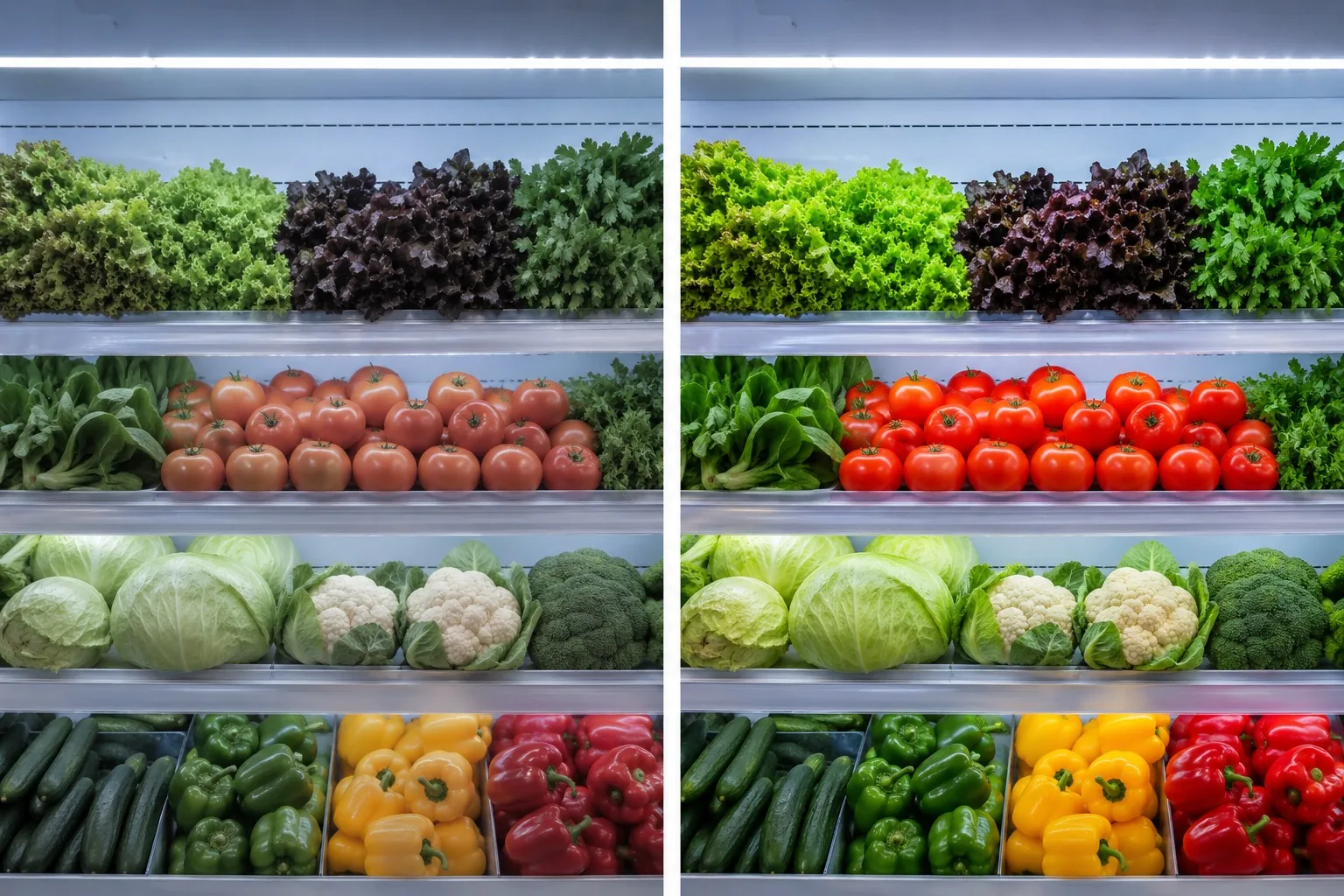
The jump from 90 to 95 is smaller than the jump from 80 to 90. But in retail, that final gap determines whether a tomato looks appetizing or merely acceptable.
When CRI 95+ Pays for Itself
Not every shelf justifies premium color rendering. Use this framework:
| Retail Segment | CRI 90 Sufficiency | CRI 95+ Value | Payback Driver |
|---|---|---|---|
| Supermarket fresh food | Acceptable for packaged goods | Critical for meat, produce, deli | Higher basket size, reduced markdowns |
| Cosmetics and beauty | Adequate for shelf display | Essential for trial counters | Lower return rates, higher conversion |
| Jewelry and watches | Poor — metals look flat | Required for gemstone fire and metal luster | Perceived value increase, longer dwell time |
| Apparel and fashion | Adequate for basic collections | Important for premium and seasonal lines | Fewer color-mismatch returns |
| Electronics | Usually sufficient | Minimal impact | Low priority |
| Warehouse and discount | Sufficient | No measurable return | Not recommended |
The Hidden Cost of CRI 90 in Fresh Food
A supermarket produce section under CRI 90 lighting looks decent at first glance. Greens are green. Oranges are orange. But the subtle desaturation in red wavelengths affects customer behavior in ways that do not show up on lighting invoices.
Meat appears slightly brown instead of fresh red. Customers perceive lower quality and reach for alternatives. Tomatoes lose the vibrant saturation that signals ripeness. The result is not a direct complaint. It is a lower basket size and higher spoilage rate.
For a fresh-focused store, the 15 to 25 percent premium for CRI 95+ typically recovers within one produce cycle through reduced markdowns and higher sales velocity.
How to Verify Supplier Claims
Many suppliers label products CRI 95+ while delivering 92 or 93. Procurement teams should require three documents before placing an order:
Independent test report. Request IES LM-79 or equivalent testing from a third-party lab, not an in-house certificate. The report should list CRI, R9 red rendering, and TM-30 color fidelity values.
Batch-level verification. Color quality varies between LED chip batches. Ask for binning data showing 3-step MacAdam ellipse tolerance or tighter. Generic certificates cover the chip manufacturer’s average, not the actual batch installed in your fixtures.
Physical demo with your products. Bring three items to the supplier’s showroom: a red apple or tomato, a piece of white fabric, and a skin-tone reference. Under true CRI 95+, the red looks saturated, the white looks clean without pink or green cast, and the skin tone looks natural. Under CRI 90, subtle distortion appears in at least one of the three.
ARMOR’s Approach to Color Quality
All ARMOR retail lighting fixtures use CRI 95+ LED modules as standard, not as an upsell option. Modules are binned to 3-step MacAdam ellipse tolerance, ensuring color consistency across an entire store installation.
Batch-level CRI test reports are available on request. These show the actual test data for the specific LED chips in your order, not generic manufacturer averages.
Decision Checklist
Before specifying CRI 95+, confirm three things:
- Your segment benefits from color precision. Fresh food, cosmetics, jewelry, and premium apparel see measurable returns. Electronics and discount retail do not.
- Your margin supports the premium. If average transaction value is under $20 and color is not a primary purchase driver, CRI 90 may be the rational choice.
- Your supplier can prove the claim. Request independent test reports, batch data, and a physical demo. Do not trust datasheet numbers alone.
Request Specification Support
ARMOR provides lighting specification assistance for retail projects, including CRI recommendations by segment, sample evaluation kits, and batch test report documentation.
Contact: Lisa@armorlighting.com | +86 13672469002
Planning a Retail Lighting Project?
Need help applying this lighting approach to your fixture?
If you're evaluating retail lighting, fixture lighting, or lighting configuration for a fixture, tell us what you're working on.
Related to what you're reading
CRI 90 vs 95+: A Buyer's Decision Framework for Retail Lighting
Related Articles
View All Articles »
Setting Shelf-Level Specs for Product-Focused Retail Lighting
Ceiling accent spots do their best work on feature walls and end caps, where a narrow beam has a clear path. On a packed gondola, that beam can be blocked before it reaches a stocked middle shelf. The aisle may look bright while the second or third shelf remai
Best Grocery Store Categories for LED Shelf Lighting: A Buyer's Guide
Not every shelf in a grocery store needs the same light. A deli case and a beverage cooler serve different products, different shoppers, and different margins. But one thing is consistent: grocery store shelf lighting directly affects how shoppers see and buy

Why Fresh Food Display Lighting Is the First Lighting Decision Supermarkets Regret Getting Wrong
Every supermarket makes two lighting decisions at the planning stage: the ambient lighting for the overall store, and the shelf lighting for product displays. The second one gets less budget attention — and that is where the regrets start. Fresh food display l
Why Retail Chains Are Installing Shelf Lighting Without an Electrician in 2026
Every retail chain that has upgraded shelf lighting in the past decade has hit the same wall: the fixture is ready, the budget is approved, and then you have to wait three weeks for a licensed electrician to wire it. That wall is becoming less necessary. In 20