

Why Fresh Food Display Lighting Is the First Lighting Decision Supermarkets Regret Getting Wrong
Every supermarket makes two lighting decisions at the planning stage: the ambient lighting for the overall store, and the shelf lighting for product displays. The second one gets less budget attention — and that is where the regrets start. Fresh food display l
On this page
Every supermarket makes two lighting decisions at the planning stage: the ambient lighting for the overall store, and the shelf lighting for product displays. The second one gets less budget attention — and that is where the regrets start.
Fresh food display lighting is not a commodity. It operates in a different context than general retail lighting: the products it illuminates are living, perishable, and communicate freshness visually in a way that packaged goods never do. Get it wrong, and the consequences show up in the produce section within weeks of opening. Get it right, and it quietly supports higher sales, lower shrink, and a shopping experience that feels genuinely fresh.
This guide covers the technical decisions that supermarket buyers and store designers face when specifying fresh food display lighting — and why those decisions need to happen before the shelving goes in, not after.
Why Fresh Food Lighting Is Different From General Retail Lighting
Packaged goods sit under general retail lighting just fine. The packaging does the talking. Color accuracy is a nice-to-have. Light temperature is irrelevant to the product itself.
Fresh food is different. The product is the visual signal. A head of lettuce that looks crisp and bright under the right light looks dull and tired under the wrong one — in the same way, by the same customer, in the same store.
The core difference is what fresh food lighting has to communicate: freshness. Not brand identity, not product information, not aesthetic mood — actual biological freshness. That changes which metrics matter and which mistakes are expensive.
Three structural differences define fresh food lighting requirements:
The product is the message. In packaged goods retail, the lighting environment can be fairly neutral. In fresh food, the light is part of the product presentation. If the light makes the food look worse, the product fails — regardless of how fresh it actually is.
Temperature sensitivity. Refrigerated cases, deli counters, and hot food displays all operate in environments that create specific lighting constraints — especially around heat output. A light source that runs hot in a refrigerated case creates condensation, accelerates spoilage, and defeats its own purpose.
Category variation. Produce, meat, fish, bakery, and dairy each respond differently to the same light spectrum. A single light temperature that works acceptably for all of them is a compromise that works well for none of them.
Most supermarkets that regret their fresh food lighting made the same mistake: they specified it as a subset of general retail lighting rather than as a distinct discipline.
The Color Rendering Index (CRI) Problem: Why Ra80 Lights Are Costing You Sales
The Color Rendering Index — commonly referred to as CRI — measures how accurately a light source reveals the true colors of objects compared to natural daylight. It is expressed as a number from 0 to 100. The higher the number, the more accurately colors appear.
For general retail environments, a CRI of Ra80 — the minimum standard for most commercial LED applications — is acceptable. For fresh food display, it is consistently too low.
The reason is in the spectrum. A standard Ra80 LED light source produces a relatively compressed range of visible wavelengths. It renders some colors faithfully and mutes others — particularly in the red and green ranges that give fresh produce much of its visual appeal.
What this looks like in practice:
- Leafy greens (kale, spinach, lettuce) appear muted and slightly grey-green rather than vibrant
- Red and purple produce (strawberries, grapes, cabbage) lose the depth and richness that signal ripeness
- Citrus fruits look less golden and more pallid
- Bananas lose the bright yellow signal that communicates “ready to eat”
The Illuminating Engineering Society (IES) defines CRI using eight standardized test color samples. For fresh food retail, the most relevant samples are the red (R9) and yellow-green (R11) swatches — precisely the colors that convey freshness in produce.
Retail lighting specialists and fresh food merchandisers increasingly recommend Ra90 or higher for produce and deli lighting, with Ra95+ preferred for meat displays where color accuracy directly affects perceived quality and purchase decisions.
The cost difference between Ra80 and Ra95 LED fixtures is real — typically 15-40% depending on the manufacturer and fixture type. That difference is recovered quickly in reduced shrink (less produce binned because it looks worse than it is), higher average basket size (customers buy more produce that looks better), and fewer customer returns or passes.
What to specify: Ra90 minimum for general fresh food zones. Ra95+ for meat, fish, and premium produce sections. Ask your supplier for the R9 score specifically — CRI is an average, and a light can score well on average while still rendering reds poorly.
Color Temperature: Choosing the Right Kelvin for Each Fresh Food Category
Color temperature, measured in Kelvin (K), describes whether a light source appears warm (yellowish) or cool (bluish). It is a separate property from CRI — a light can be warm and high-CRI, or cool and high-CRI, or any combination.
For fresh food display, color temperature needs to be matched to the food category — and this is where most supermarket lighting specifications fall short.
Here is how different fresh food categories respond to color temperature:
| Food Category | Recommended Kelvin Range | Rationale |
|---|---|---|
| Fresh produce | 3,000–4,000K | Warm-neutral range preserves greens and reds without adding artificial warmth |
| Meat (raw) | 2,700–3,200K | Warm light enhances red tones in beef, lamb, and pork — but avoid going too warm or meat looks brown |
| Poultry | 3,500–4,000K | Slightly cooler than red meat; preserves pink tones without washing out the natural color |
| Fish and seafood | 4,000–5,000K | Cooler light prevents the warm cast that makes fish look yellowish or past its prime |
| Bakery | 2,500–3,000K | Warm golden light is intentional here — it makes bread, pastries, and desserts look freshly baked and inviting |
| Deli and prepared foods | 3,500–4,000K | Neutral-warm range works across the variety; avoid mixing temperatures within the same case |
The practical implication for supermarket design teams is that a single uniform Kelvin specification across all fresh food sections is the wrong approach. The bakery needs to look warm and golden. The fish counter needs to look clean and bright. These are contradictory requirements, and the lighting needs to be specified accordingly.
Modern zoning-capable LED systems make this practical — a single LED fixture family with adjustable color temperature outputs can be dialed per section at installation. This is increasingly standard in new builds. For retrofits, plug-and-play LED bars in the correct Kelvin for each section are a straightforward upgrade.
What to specify: Match Kelvin to category, not to store standard. Verify that the fixture can produce the target Kelvin consistently across the fixture lifespan — some LED products shift slightly cooler as they age.
Lux Levels: Finding the Right Brightness Without Bleaching or Shadowing
Lux (lx) measures the amount of light reaching a surface — in this case, the shelf where fresh food sits. More is not always better.
Too little light and the product looks dim and unappealing. Too much light and the product appears washed out and artificial — a phenomenon sometimes called “bleaching” in produce displays, where the natural highlights and shadows that give depth to a product display are flattened under excessive brightness.
The target lux level depends on the specific zone:
Produce and fresh水果蔬菜: 500–800 lux at product level. This range provides sufficient illumination to make colors vivid without creating the flat, over-illuminated look that actually reduces visual appeal. High-end specialty grocers sometimes push toward 1,000 lux for feature displays, but this is the ceiling — beyond it, the product appearance deteriorates.
Meat and poultry: 400–600 lux. Meat does not need as much illumination as produce — the visual impact comes from color accuracy rather than brightness. Over-lighting meat actually degrades its appearance, making premium cuts look dry and pale.
Fish and seafood: 600–800 lux. The cool blue-white range of fish requires brighter illumination to look fresh and clean, particularly in ice displays where reflected light can reduce effective brightness.
Bakery: 300–500 lux. Warm bakery lighting does not need to be bright — in fact, intentional lower brightness reinforces the cozy, fresh-from-the-oven impression. Bright bakery lighting can actually make pastries look dry and industrial rather than handmade and inviting.
Avoiding shadowing is as important as hitting the right lux number. Recessed shelf lights or fixtures mounted too far from the product create uneven illumination — bright at the front of the shelf, dim toward the back. Surface-mounted or clip-on LED bars positioned close to the product plane provide more even light distribution across the shelf depth. The goal is uniform lux across the entire display, not a bright spot that fades toward the back.
What to specify: Target lux at product level, not at fixture level — these are different measurements. Ask your supplier for photometry data showing lux distribution across the shelf. Uniformity ratio (minimum lux / average lux) should be above 0.7 for fresh food displays.
UV and Infrared: Eliminating Heat Damage in Deli and Bakery Displays
Most fresh food lighting specifications focus on visible light. But the invisible spectrum matters equally for fresh food — particularly the infrared (IR) and ultraviolet (UV) output of the light source.
Conventional halogen and incandescent light sources emit significant infrared radiation, which generates heat at the product surface. In a refrigerated case or ambient fresh food display, this additional heat load accelerates spoilage and condensation. In a deli counter with hot food, it compounds an already challenging thermal environment.
LED sources emit essentially no IR radiation when properly designed — this is one of their significant advantages over older lighting technologies for fresh food applications. However, not all LED products are equal in this regard. The LED chip itself can produce some radiant heat, and poorly designed fixtures can trap that heat close to the product.
For deli and bakery displays specifically:
Heat-sensitive foods (cut fruits, prepared salads, chocolate desserts): LED lighting with zero IR output eliminates the radiant heat contribution that accelerates melting, discoloration, and microbial growth. The cooler display case temperature extends product shelf life measurably.
Bakery warm cases operate intentionally at elevated temperatures to keep baked goods at serving temperature. The lighting in these cases should be evaluated for its heat contribution to the product zone specifically — not just to the overall case interior. A fixture that runs cool at the LED chip but conducts heat through its housing into the product zone still creates a problem.
Refrigerated fresh food displays benefit most from LED’s zero-IR characteristic. Removing the radiant heat load from the lighting system means the refrigeration system has less work to do, which contributes to overall energy savings on top of the product quality benefit.
UV output from lighting is less common in commercial LED products than IR, but it is worth verifying for sensitive applications. High-UV light sources can accelerate photo-oxidation in cut produce and accelerate color degradation in pre-packaged fresh foods. The FDA’s labeling requirements for certain foods also create compliance considerations around UV exposure in display environments.
What to specify: Request IR and UV test data from your supplier. For refrigerated and deli cases, specify LED fixtures with verified zero IR output at the product zone. For ambient bakery and deli displays, confirm the fixture housing does not conduct significant heat to the product surface.
Energy and Maintenance: Calculating the True Cost of Fresh Food Lighting
Fresh food display lighting operates for extended hours — most supermarkets run full fresh food section lighting from store open to close, and many run overnight for restocking. This means the energy and maintenance profile of fresh food lighting has a larger financial impact than the same fixture specifications would in a low-hours general lighting application.
A full LED replacement for fresh food display lighting typically delivers:
Energy reduction of 50-70% compared to equivalent-output fluorescent or halogen fixtures. A 40W fluorescent tube replaced by a 15-18W LED bar at equivalent light output represents a 55-60% energy reduction — at 12+ hours per day, 365 days per year, this compounds into a meaningful operating cost difference.
Maintenance cost elimination. Fluorescent tubes in fresh food environments fail faster than in standard environments — temperature cycling in refrigerated cases and humidity in produce zones both reduce fluorescent tube lifespan. The standard replacement cycle for fresh food area fluorescent tubes is 12-18 months in many operations. LED fixtures in the same environments routinely operate for 50,000+ hours (which, at 12 hours per day, is over 11 years) with no maintenance intervention.
Reduced refrigeration load. As noted above, LED fixtures with zero IR output reduce the heat load on refrigerated cases. This translates directly into lower refrigeration energy consumption — an effect that compounds across every refrigerated case in the fresh food section.
For a medium-sized supermarket (approximately 800m² of retail space), a conservative estimate for the annual energy cost of fresh food display lighting:
| Technology | Fixture Count (est.) | Watts per Fixture | Annual kWh (@14hr/day, 365 days) | Annual Energy Cost (@$0.12/kWh) |
|---|---|---|---|---|
| Fluorescent T8 | 80 | 36W + 10% ballast | 184,128 | $22,095 |
| LED (standard) | 80 | 15W | 61,320 | $7,358 |
| LED (high-efficiency) | 80 | 12W | 49,056 | $5,887 |
The LED option costs roughly $14,000-16,000 less per year in energy alone — before the maintenance savings from eliminating lamp replacements are even counted.
What to specify: Calculate total cost of ownership over a 5-year period, not just first cost. Energy, maintenance, and replacement cycles all belong in the comparison. The fixture with the lowest first cost is rarely the lowest total cost.
How to Specify Fresh Food Lighting for Your Supermarket: A Buyer’s Checklist
These are the specifications that matter when buying fresh food display lighting. Run through each one before confirming an order.
Color rendering (CRI): Ra90 minimum for all fresh food zones. Ra95+ for meat, fish, and premium produce. Request R9 (red) scores specifically — the average CRI can obscure poor red rendering.
Color temperature (Kelvin): Match to category. Do not accept a single Kelvin specification across all fresh food sections. Required ranges: bakery 2,500–3,000K; meat 2,700–3,200K; produce 3,000–4,000K; fish 4,000–5,000K.
Lux level: Specify target lux at product level (shelf surface), not at fixture. Ask for photometry data showing lux distribution across shelf depth. Target uniformity ratio ≥ 0.7.
IR/UV output: Zero IR at product zone for refrigerated and deli cases. Verify with test data — do not assume “LED” means zero IR.
Operating temperature range: Confirm fixture performance in refrigerated environments (typically 0–4°C) and in deli/hot food areas (up to 30°C+). LED driver and chip performance can vary significantly across these ranges.
IP rating: For open fresh food displays (particularly produce misting zones), specify IP44 minimum. For refrigerated case lighting, IP67 is preferred to protect against condensation and cleaning cycles.
Mounting compatibility: Verify that the fixture mounting system is compatible with your gondola shelving profile. Clip-on magnetic systems work well for standard steel gondola shelving. Surface-mount options are needed for non-ferrous or wood shelving.
Dimming and zoning: Confirm whether fixtures need to be dimmable or adjustable in color temperature. These features require compatible drivers and typically a lighting control system — verify compatibility before purchase.
Certification: Required certifications depend on market. For US market: UL or ETL listed. For EU market: CE marked and RoHS compliant. For food-handling environments: verify that the fixture housing materials are food-safe and do not off-gas in enclosed refrigerated cases.
Warranty and lifespan: Commercial LED fixtures should carry a minimum 3-year warranty. Confirm lumen maintenance data (LM-80 or TM-21 testing) showing predicted output at 50,000 hours.
Frequently Asked Questions
What is the best CRI for fresh food display lighting in supermarkets?
Ra90 minimum for general fresh food zones, Ra95+ for meat, fish, and premium produce sections. The higher the CRI, the more accurately colors are rendered — which directly affects how fresh and appealing fresh food appears to customers. A CRI of Ra95 means the light source renders colors that are 95% as accurate as natural daylight. Standard commercial LED at Ra80 commonly falls short for fresh food applications, particularly in the red and yellow-green wavelengths most important for produce.
What color temperature (Kelvin) is best for produce lighting?
The recommended range for fresh produce lighting is 3,000–4,000K. Within this range, cooler temperatures (toward 4,000K) work well for green vegetables and bright produce; slightly warmer temperatures (toward 3,000K) enhance root vegetables and citrus. The key principle is that a single Kelvin specification across all fresh food categories is wrong — bakery needs 2,500–3,000K, meat needs 2,700–3,200K, and fish needs 4,000–5,000K to look its best.
How many lux does a supermarket fresh food section need?
Produce displays need 500–800 lux at the shelf surface; meat and poultry need 400–600 lux; fish and seafood need 600–800 lux; bakery needs 300–500 lux. Uniformity matters as much as absolute level — the minimum lux divided by the average lux should be 0.7 or higher across the shelf depth to avoid a “hot spot” appearance at the front with dim back-of-shelf shadows.
Do LED lights cause food to spoil faster due to UV or heat?
Properly specified LED lights cause food to spoil more slowly than older lighting technologies. LED sources emit essentially zero UV and zero infrared radiation, which reduces heat load on the product and eliminates photo-oxidation damage. Standard fluorescent and halogen sources produce both IR heat and trace UV that can accelerate discoloration and spoilage in sensitive fresh foods. Always verify with your supplier that the specific fixture has zero IR output at the product zone — not all LED products are equal in this regard.
What is the energy cost of fresh food display lighting per year?
For a medium-sized supermarket with approximately 80 fresh food display fixtures running 14 hours per day, the annual energy cost is roughly $22,000 with fluorescent technology versus $5,800–7,400 with LED (depending on fixture efficiency). At 12+ operating hours per day across large fresh food sections, the energy savings alone from LED replacement typically produces a full return on investment within 18–36 months — before the maintenance savings from eliminating lamp replacements are counted.
How does fresh food lighting affect customer purchasing behavior?
Fresh food lighting directly affects purchase behavior through perceived product quality. Studies in visual merchandising consistently show that produce and meat displayed under high-CRI, correctly temperatured lighting is perceived as fresher, more premium, and worth a higher price than the same product under standard lighting. Customers use visual cues from the product itself — particularly color vibrancy and surface moisture — to assess freshness. Lighting that degrades these cues reduces perceived quality and increases product shrink as items pass their visual peak before their actual peak.
Can I use standard shelf lights in a refrigerated fresh food case?
Standard shelf lights are not recommended for refrigerated cases. Refrigerated environments create condensation, temperature cycling, and specific humidity conditions that require fixtures with appropriate IP ratings (IP67 preferred) and operating temperature ratings. Standard shelf lights may also have driver components that perform inconsistently in cold temperatures, causing flickering or reduced output. For refrigerated fresh food cases, specify fixtures rated for the operating temperature range and with verified cold-temperature performance data.
ARMOR Lighting focuses on retail and display lighting. For fresh food display lighting specifications, custom Kelvin and CRI options, and project pricing, visit ARMOR’s retail lighting products or contact ARMOR’s sales team.
Related Product Families
- Fresh Food & Display Lighting
Browse lighting products designed for fresh food cases and retail display environments.
Retail Lighting →
Planning a Retail Lighting Project?
Need help applying this lighting approach to your fixture?
If you're evaluating retail lighting, fixture lighting, or lighting configuration for a fixture, tell us what you're working on.
Related to what you're reading
Why Fresh Food Display Lighting Is the First Lighting Decision Supermarkets Regret Getting Wrong
Related Articles
View All Articles »
Setting Shelf-Level Specs for Product-Focused Retail Lighting
Ceiling accent spots do their best work on feature walls and end caps, where a narrow beam has a clear path. On a packed gondola, that beam can be blocked before it reaches a stocked middle shelf. The aisle may look bright while the second or third shelf remai
How Retailers Are Cutting Energy Costs 20-40% With LED Shelf Lighting Upgrades
Retail stores waste 25-35% of the energy they consume, according to the US Environmental Protection Agency. For a single-location store, that waste translates to $9,000-$18,000 per year in preventable spending. Across a 10-store chain, you are looking at $90,0
Best Grocery Store Categories for LED Shelf Lighting: A Buyer's Guide
Not every shelf in a grocery store needs the same light. A deli case and a beverage cooler serve different products, different shoppers, and different margins. But one thing is consistent: grocery store shelf lighting directly affects how shoppers see and buy
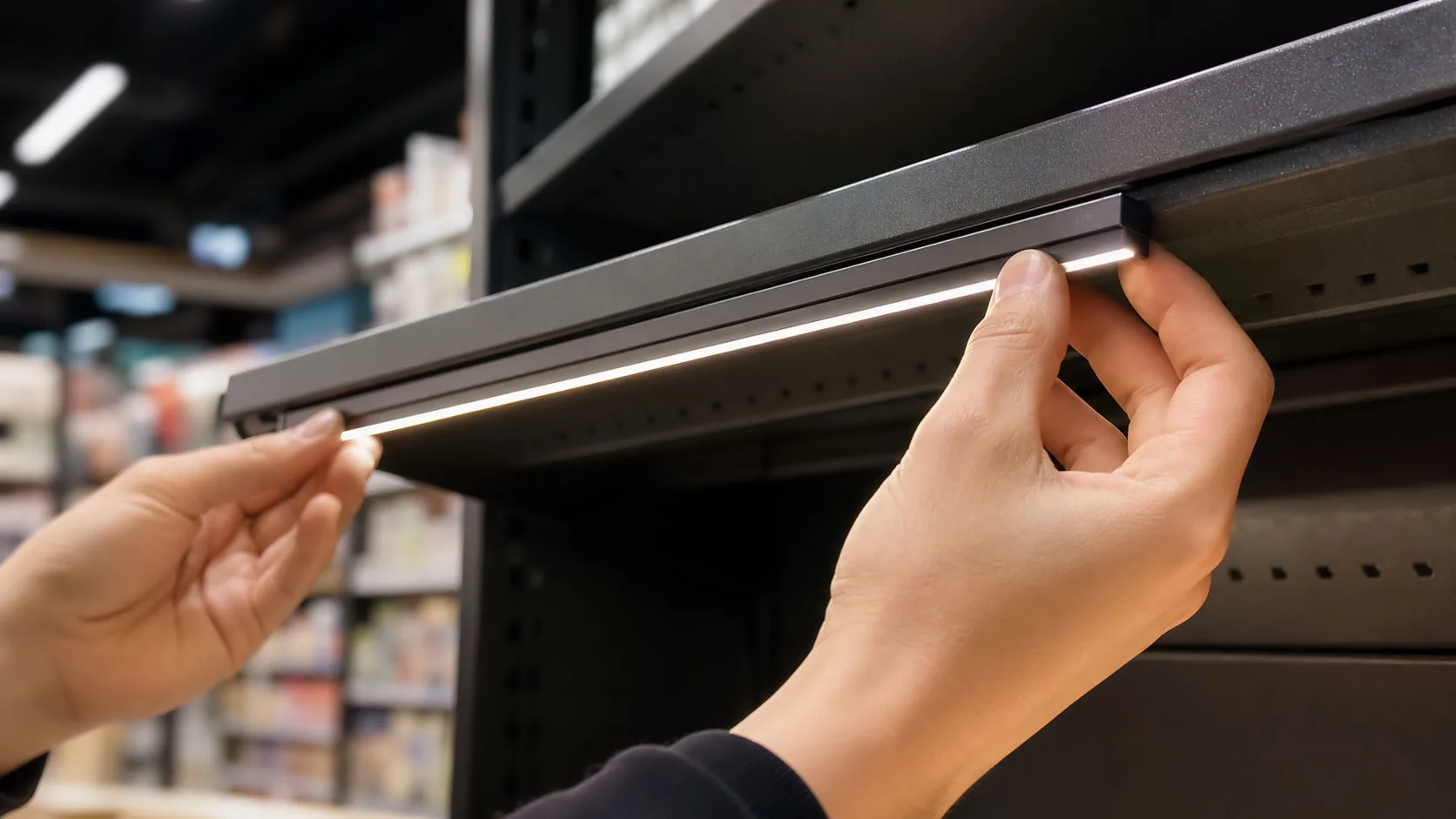
Why Retail Chains Are Installing Shelf Lighting Without an Electrician in 2026
Every retail chain that has upgraded shelf lighting in the past decade has hit the same wall: the fixture is ready, the budget is approved, and then you have to wait three weeks for a licensed electrician to wire it. That wall is becoming less necessary. In 20