

Setting Shelf-Level Specs for Product-Focused Retail Lighting
Ceiling accent spots do their best work on feature walls and end caps, where a narrow beam has a clear path. On a packed gondola, that beam can be blocked before it reaches a stocked middle shelf. The aisle may look bright while the second or third shelf remai
On this page
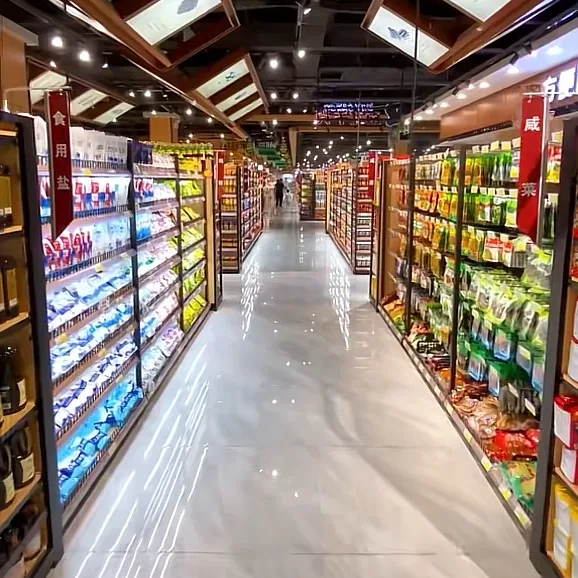
Ceiling accent spots do their best work on feature walls and end caps, where a narrow beam has a clear path. On a packed gondola, that beam can be blocked before it reaches a stocked middle shelf. The aisle may look bright while the second or third shelf remains poorly lit. Ambient light will not correct that shadow; product-focused retail lighting has to be specified where the merchandise sits, with the zone determining color quality, protection rating, and power layout.
What the 2026 supplier guides actually tell you
The 2026 supplier guides from Luminati and Starbeam emphasize focused fixtures, adjustable beams, and higher color rendering. Westgate sets CRI 90+ as a merchandising baseline for retail displays. These are supplier recommendations, not an industry standard or measured market data. They give a direction, but they cannot set targets for a store whose departments, cases, and shelf materials they do not know.
The specs change with the zone
Where color matters — fresh food or packaging with tightly controlled brand colors — start with color rendering. CRI, the Color Rendering Index, scores how accurately a light renders colors on a 0-100 scale. Supplier guidance sets CRI 90+ as a retail-display baseline; for fresh food and other color-critical goods, CRI 95 with a strong R9 is the safer target. R9 measures saturated-red rendering. Because CRI averages several sample colors, a weak red result can be hidden inside a high overall score. That matters at meat counters and produce displays. Red-toned packaging can expose the same weakness. The guide to color temperature and CRI in retail lighting buying decisions explains the relationship in more detail.
Color temperature depends on the department rather than a store-wide preference. Industry practice recommends a warm 2700-3000K for meat and seafood zones. General grocery shelves typically use a neutral setting around 4000K. These are practice-based recommendations, not measured sales claims; the grocery store shelf lighting guide by department covers the zone differences in more detail.
IP rating enters when the zone creates moisture. Cold cabinets and refrigerated cases produce condensation and get cleaned regularly, so they call for IP65. Dry indoor shelves take IP20. An IP20 fixture in a cold cabinet has no moisture protection to fall back on; the cabinet’s cleaning routine becomes part of the fixture’s operating conditions. It is a hard constraint on where the fixture can live.
ARMOR’s magnetic shelf light bars list Ra>95 with R9>60, an adjustable 3000K-6000K CCT range, 24-volt DC input, and 15W/m, with IP20 indoor and IP65 cold-cabinet versions (ARMOR Product Knowledge Base). These are product-line specifications, not default targets for every zone in a store.
| Zone | CCT | Color rendering | IP |
|---|---|---|---|
| Meat and seafood | 2700-3000K warm | CRI 90+; 95 with strong R9 for color-critical displays | IP65 in refrigerated cases |
| General grocery, dry shelves | ~4000K neutral | CRI 90+ | IP20 |
Power and mounting
Fixtures can be replaced later. The power layout is harder to undo. Per-fixture hardwiring fixes each light in place, so moving it means disconnecting and re-running the wiring. A low-voltage power track feeds fixtures along a rail and allows repositioning without per-fixture rewiring. That is a product capability, not a measured labor or cost claim; its practical value depends on how often the store resets displays.
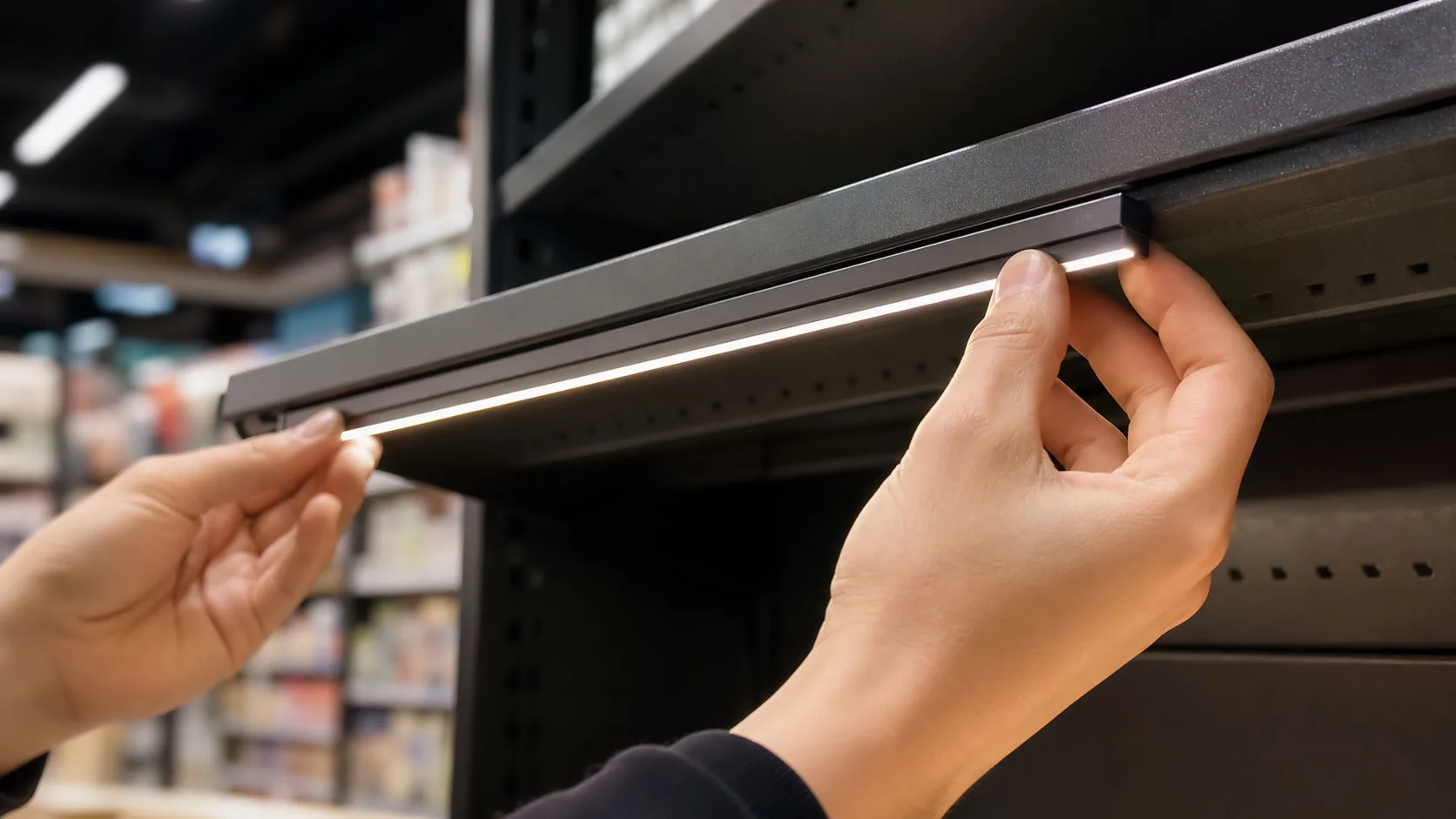
Magnetic mounting is movable only when the shelf surface is ferromagnetic steel. Compatible steel shelving allows the bars to attach without tools and draw power from the track; wood and non-magnetic surfaces require a different mounting decision. Shelf material and the existing power layout therefore have to be checked together. ARMOR’s wireless power track family includes the Ultra Thin Shelf Power Track, Mini Power Track, Super-Thin Magnetic Power Track, and Wireless Power Track with Socket. Certification is product-specific: the track-family rows list CE, CULUS, ERP, ETL, FCC, PSE, ROHS, TUV, and UL, while the bar row lists CE, RoHS, and ETL (ARMOR Product Knowledge Base). The applicable marks still need to be checked for the selected product and market.
Start with one difficult zone
Do not begin with the whole store. Choose a hero display, fresh-food case, or shelf area where the current lighting clearly misses the target. Set CRI/R9, CCT, and IP for that zone before comparing fixtures, then decide the fixture and power layout together. If the display moves regularly, include that requirement in the power decision. The gondola shelving lighting guide covers selection and installation for that layout.
Include cleaning access and lamp replacement in the pilot. For a shelf-level layout review, send the zone list and shelf type.
Related Product Families
- Shelf & Cabinet Lighting
Browse ARMOR shelf and cabinet lighting products for retail fixtures, gondolas, showcases, and cabinets.
Retail Lighting →
Planning a Retail Lighting Project?
Need help applying this lighting approach to your fixture?
If you're evaluating retail lighting, fixture lighting, or lighting configuration for a fixture, tell us what you're working on.
Related to what you're reading
Setting Shelf-Level Specs for Product-Focused Retail Lighting
Related Articles
View All Articles »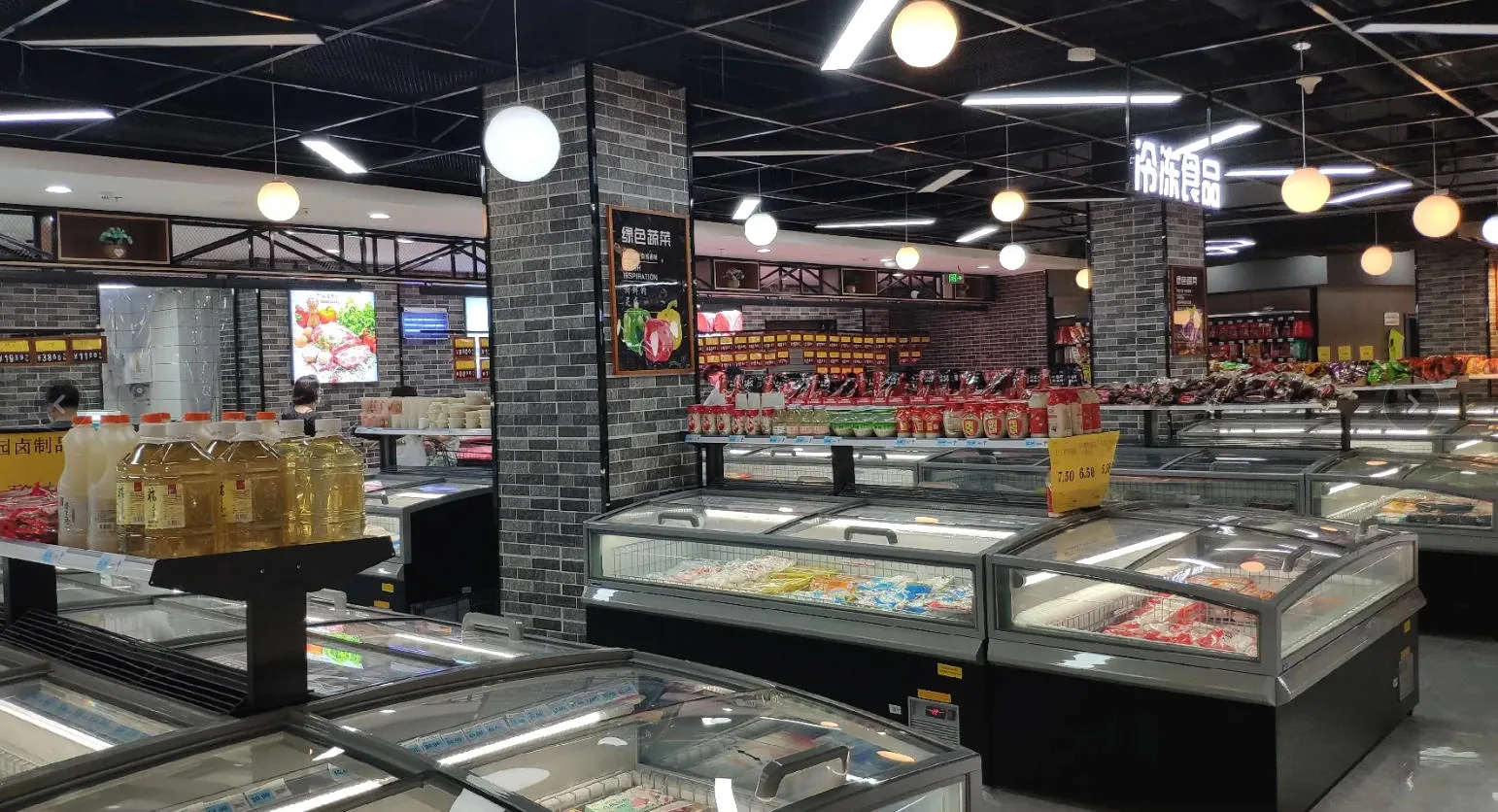
Best Grocery Store Categories for LED Shelf Lighting: A Buyer's Guide
Not every shelf in a grocery store needs the same light. A deli case and a beverage cooler serve different products, different shoppers, and different margins. But one thing is consistent: grocery store shelf lighting directly affects how shoppers see and buy

Why Fresh Food Display Lighting Is the First Lighting Decision Supermarkets Regret Getting Wrong
Every supermarket makes two lighting decisions at the planning stage: the ambient lighting for the overall store, and the shelf lighting for product displays. The second one gets less budget attention — and that is where the regrets start. Fresh food display l
Why Retail Chains Are Installing Shelf Lighting Without an Electrician in 2026
Every retail chain that has upgraded shelf lighting in the past decade has hit the same wall: the fixture is ready, the budget is approved, and then you have to wait three weeks for a licensed electrician to wire it. That wall is becoming less necessary. In 20
How Retailers Are Cutting Energy Costs 20-40% With LED Shelf Lighting Upgrades
Retail stores waste 25-35% of the energy they consume, according to the US Environmental Protection Agency. For a single-location store, that waste translates to $9,000-$18,000 per year in preventable spending. Across a 10-store chain, you are looking at $90,0