

Why Retail Chains Are Installing Shelf Lighting Without an Electrician in 2026
Every retail chain that has upgraded shelf lighting in the past decade has hit the same wall: the fixture is ready, the budget is approved, and then you have to wait three weeks for a licensed electrician to wire it. That wall is becoming less necessary. In 20
On this page
Every retail chain that has upgraded shelf lighting in the past decade has hit the same wall: the fixture is ready, the budget is approved, and then you have to wait three weeks for a licensed electrician to wire it.
That wall is becoming less necessary.
In 2026, magnetic shelf lighting technology has matured enough to eliminate the electrician from the majority of standard retail shelf lighting installations — particularly for steel gondola shelving, which represents the majority of shelf formats in supermarkets, warehouse clubs, drugstores, and mass merchants worldwide.
The result: installation that once required licensed contractors, scheduled downtime, and thousands in labor costs can now be completed by store staff in seconds per bay. This is not a niche workaround — it is an industry shift that is changing how retail chains budget and execute lighting upgrades.
The Installation Problem Retailers Keep Running Into
Before magnetic shelf lighting became viable at commercial scale, the standard retail LED installation process looked like this: a facilities manager coordinates with an electrical contractor, the contractor schedules a site visit, shelves are cleared in the affected section, wiring channels are routed through or behind gondola uprights, junction boxes are installed, and finally the lights are connected. For a 100-bay store, this can mean multiple days of work — and a significant portion of that time is electrician labor.
The cost picture is equally uncomfortable. According to 2026 LED retrofit labor data from Luminate Lighting Group, electrician labor for commercial lighting projects typically ranges from $85 to $125 per hour. For individual fixture installations — where each light requires physical mounting, wiring, and circuit testing — costs commonly run $50 to $100 per unit before the fixture itself is even purchased.
For a supermarket with 100 shelf bays, each requiring one or more light fixtures, wired installation labor alone can reach $5,000 to $10,000 per location. Chain operators with 50 stores or 500 stores face this cost multiplied — not as a one-time project expense, but every time a lighting layout changes.
Beyond the direct labor cost, there are secondary costs that rarely appear in project budgets:
- Scheduling delay: Licensed electricians are frequently booked 2-4 weeks out, extending project timelines significantly
- Store disruption: Sections must be cleared, shelves emptied, and sometimes operations disrupted to provide access for wiring
- Coordination overhead: Each installation requires a project manager to coordinate between the lighting supplier, electrical contractor, and store operations
- Maintenance lock-in: When a lamp fails or a planogram changes, the cycle repeats — electrician, scheduling, cost
These are not edge cases. For chain operators who have managed multiple store lighting retrofits, these friction points are the rule, not the exception.
How Magnetic Shelf Lighting Changes the Installation Equation
Magnetic shelf lighting resolves the electrician dependency by separating the electrical installation from the physical installation.
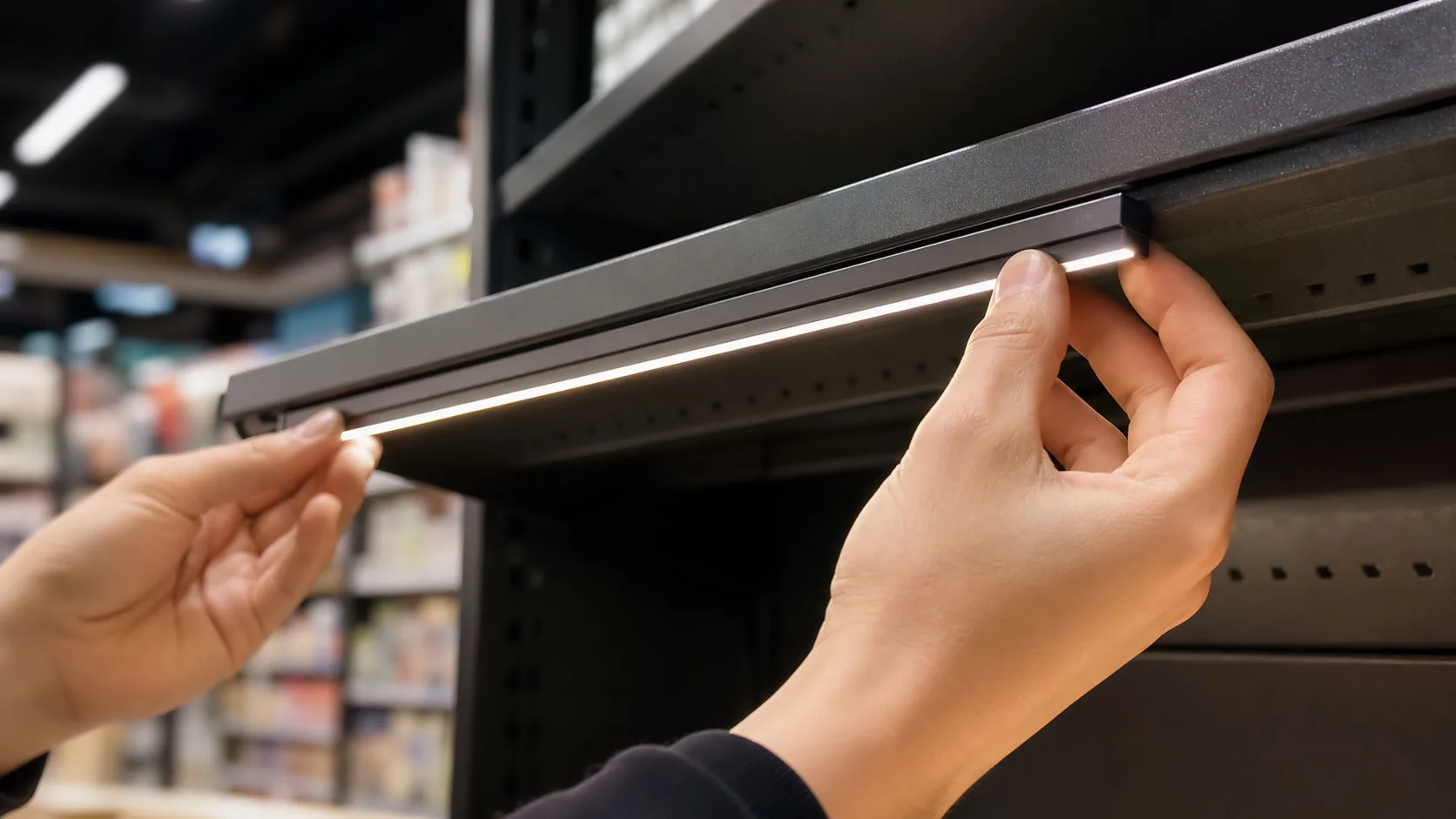
The mechanism is straightforward: a magnetic strip — or in the case of ARMOR’s design, a ferrous backing integrated into the shelf profile or a magnetic mounting surface on the light itself — creates a mechanical attachment to steel shelving that requires no screws, no clips, and no tools. The electrical connection is handled separately, typically through a DC power rail or low-voltage plug-in adapter that does not require hardwiring.
This approach works because most retail gondola shelving is built on steel uprights and shelf supports. Steel provides both the structural strength for magnetic attachment and the ferromagnetic surface that holds the light securely — even under the vibration and contact that occurs in a busy retail environment.
The practical benefits compound quickly:
No electrician required for physical installation. Store staff — or a single facilities team member — can mount magnetic shelf lights directly onto steel shelving. There is no drilling into gondola uprights, no routing of wiring channels, and no need for a licensed electrical contractor.
No hardwiring in the shelf environment. Because magnetic shelf lights operate on low-voltage DC power (typically DC24V), the electrical connection is made through a plug-in adapter or power rail rather than hardwired circuits. This eliminates the electrical permitting and licensed electrician requirements that make wired installations costly and slow.
Removable and repositionable. When a planogram changes, the light moves with the shelf. When a lamp needs replacing, it comes off in seconds. This flexibility eliminates the “permanent commitment” problem that makes some retailers hesitant to invest in premium shelf lighting — the light is not a sunk cost that becomes obsolete with the next store reset.
Store staff installation in seconds. TITATEC, a manufacturer operating in the commercial gondola lighting space, estimates that a full gondola section can receive magnetic LED lighting in approximately 15 minutes — without any electrician involvement. For a single bay, the time drops to under 60 seconds.
The result is that a 100-bay store that would require a week of electrician-scheduled work can be fully illuminated by a small facilities team in a single day — with no electrical contractor scheduling required.
Installation Time and Labor Cost: Magnetic vs. Wired
The financial case for magnetic shelf lighting is straightforward when you isolate the installation labor variable.
| Cost Factor | Wired Shelf Lighting | Magnetic Shelf Lighting |
|---|---|---|
| Electrician labor rate | $85-125/hour | $0 (not required) |
| Hours per bay (typical) | 1-2 hours | < 60 seconds |
| Per-bay installation cost | $85-250+ per bay | $0 labor |
| Schedule dependency | 2-4 week lead time | Same-day installation |
| Store disruption | Shelves must be cleared | Minimal shelf clearance needed |
| Maintenance service call | $85-125 per visit | Store staff, no cost |
For a 100-bay store, wired installation labor can easily reach $8,500 to $25,000+ depending on site complexity and contractor rates — before the cost of the fixtures themselves. Magnetic shelf lighting eliminates that entire line item.
The 2026 data reinforces the scale of this cost: according to Suncoast Power’s commercial lighting ROI analysis, the 10-year total ROI for commercial LED lighting upgrades is approximately 340% — driven by energy savings, maintenance savings, and labor avoidance. Magnetic mounting accelerates the payback by eliminating the largest single variable cost in a traditional LED retrofit: electrician labor.
For chain operators planning a multi-store rollout, the math becomes even more compelling. A 50-store chain that eliminates $10,000 in electrician labor per location saves $500,000 in installation costs before energy savings are even calculated. At 200 stores, that number reaches $2 million.
When Magnetic Shelf Lighting Is the Right Choice
Magnetic shelf lighting is not universal — it works best in specific configurations, and understanding the fit criteria prevents costly specification errors.
Best fit: Steel gondola shelving. The magnetic attachment requires a ferromagnetic surface. Standard steel gondola shelving — the dominant format in supermarkets, hypermarkets, warehouse clubs, and mass merchants — provides an excellent hold. Verify that the steel shelf edge or backing is sufficiently thick and ferromagnetic before specifying; very thin or coated steel may not provide reliable magnetic retention.
Best fit: Stores needing frequent repositioning. Retailers who change planograms regularly — seasonal resets, promotional reconfigurations, category management changes — benefit most from magnetic lights that move with the shelf. Static installations with no expected layout changes may not need the repositionability premium.
Best fit: Retrofit over new construction. Magnetic shelf lighting delivers the clearest ROI in retrofit scenarios where the store is operational and the goal is to upgrade lighting without closing sections or running new wiring. In new store builds or major renovations, conventional wired installation may be easier to coordinate during the construction phase.
Consideration: Non-metal shelving. Wood, aluminum, glass, or particleboard shelving does not hold magnets reliably. For these environments, the options are magnetic adhesive strips (applied to the shelf surface) or alternative mounting systems. Do not specify magnetic lights for non-ferrous shelving without a verified mounting solution.
Consideration: Outdoor and wet environments. Magnetic attachment in high-humidity or outdoor environments may require additional weatherproofing considerations for both the magnetic surface and the electrical connection. Verify IP rating requirements for the specific application.
Scale matters. For a single pilot store, magnetic installation cost savings may not justify switching from a supplier you already trust. For a 50+ store chain, the cumulative electrician labor avoidance makes magnetic the default specification — unless site conditions rule it out.
ARMOR Magnetic LED Bar Lights: Tool-Free Installation from US$3.75
ARMOR has built its magnetic LED bar light series around the core principle of eliminating the electrician from shelf lighting installation.
The ARMOR magnetic LED bar light series features:
- Tool-free snap-mount installation — lights snap directly onto steel shelving, no screws, no drilling, no electrician required
- Slim 14mm profile — unobtrusive when mounted, minimizes visual impact on the shelf display
- DC24V low-voltage operation — no high-voltage exposure, simplified electrical connection
- UL and CE certification — safety certified for commercial retail environments in the US and EU
- Starting price from US$3.75 per unit — competitive with conventional LED shelf lights before installation labor is factored in
- CRI options — Ra>80 standard, Ra>90+ available for environments where accurate color rendering matters (cosmetics, fresh food, apparel accessories)
- Custom lengths — available in lengths from 550mm to 1450mm to match standard gondola bay widths
- 3-second lamp swap — when a light source fails or needs updating, replacement takes seconds without tools
The series was explicitly designed for retail chains that need to install or retrofit shelf lighting across multiple locations without the scheduling, coordination, and labor costs that conventional wired installation requires. Explore ARMOR retail lighting for the current product system.
For chain operators evaluating their next shelf lighting upgrade, the practical question is no longer “can we install this without an electrician?” — with magnetic shelf lighting, the answer is increasingly yes.
For product specifications, custom length options, and project pricing, contact ARMOR’s sales team.
Frequently Asked Questions
Can I install magnetic shelf lighting without an electrician?
Yes. Magnetic shelf lighting snaps directly onto steel shelving with no wiring, drilling, or hardwiring required. Store staff can complete the installation without a licensed electrician — typically under 60 seconds per bay, compared to hours for wired alternatives. The electrical connection is made through a low-voltage DC power adapter or rail, which does not require licensed electrical work.
How much does it cost to install LED shelf lighting with an electrician?
Electrician labor for commercial LED shelf lighting installation typically costs $85-125 per hour (Luminate Lighting Group, 2026 data), with individual fixture installation running $50-100 per unit. For a store with 100 shelf bays, wired installation labor alone can reach $5,000-25,000+ before fixture costs. Magnetic shelf lighting eliminates this entire labor cost category — store staff install without any electrician involvement.
Do magnetic shelf lights work on all types of shelving?
Magnetic shelf lights work best on steel gondola shelving — the most common format in supermarkets, warehouse clubs, and mass merchants. Standard steel provides a strong magnetic hold suitable for retail environments. For non-metal shelving (aluminum, wood, glass, or very thin steel), magnetic attachment may not be reliable. In these cases, adhesive magnetic strips or alternative mounting brackets can provide a workaround. Always verify your shelving material and steel thickness before specifying magnetic lights.
How long does it take to install magnetic shelf lighting?
A single store staff member can install magnetic shelf lighting on one bay in under 60 seconds. A full gondola section (multiple bays) can be illuminated in approximately 15 minutes based on commercial benchmarks. A 100-bay store can be fully equipped in a single day — without any electrician scheduling, shelf clearance coordination, or store downtime. This compares to days or weeks for conventional wired installation.
Are magnetic shelf lights safe for retail environments?
Yes — when properly certified. Key safety certifications to verify: UL certification (US market) and CE marking (EU market). ARMOR’s magnetic LED bar lights carry both. Additionally, DC24V low-voltage operation eliminates high-voltage exposure risk entirely, making the system safer for environments with customer-facing shelf access. The magnetic mounting is designed to resist vibration and accidental contact in busy retail settings.
What is the maintenance advantage of magnetic shelf lighting?
Magnetic shelf lights can be removed and repositioned in seconds without tools — enabling fast lamp swaps, planogram-driven repositioning, and seasonal adjustments without calling an electrician. For a chain with 50+ stores, this eliminates the ongoing cost of electrician service calls for routine maintenance: a single lamp failure that would previously require a scheduled electrician visit costing $85-125 becomes a zero-cost staff operation taking under a minute.
ARMOR has focused on retail and display lighting since 2008, serving brands including LANCOME, LEGO, NEXT, COACH, Burt’s Bees, Hasbro, Boots, BRAUN, and Marks & Spencer. For magnetic LED bar light specifications, custom lengths, and project pricing, visit ARMOR’s LED shelf light catalog.
Related Product Families
- Shelf & Cabinet Lighting
Browse ARMOR shelf and cabinet lighting products for retail fixtures, gondolas, showcases, and cabinets.
Retail Lighting →
Planning a Retail Lighting Project?
Need help applying this lighting approach to your fixture?
If you're evaluating retail lighting, fixture lighting, or lighting configuration for a fixture, tell us what you're working on.
Related to what you're reading
Why Retail Chains Are Installing Shelf Lighting Without an Electrician in 2026
Related Articles
View All Articles »
Setting Shelf-Level Specs for Product-Focused Retail Lighting
Ceiling accent spots do their best work on feature walls and end caps, where a narrow beam has a clear path. On a packed gondola, that beam can be blocked before it reaches a stocked middle shelf. The aisle may look bright while the second or third shelf remai
Best Grocery Store Categories for LED Shelf Lighting: A Buyer's Guide
Not every shelf in a grocery store needs the same light. A deli case and a beverage cooler serve different products, different shoppers, and different margins. But one thing is consistent: grocery store shelf lighting directly affects how shoppers see and buy
How Retailers Are Cutting Energy Costs 20-40% With LED Shelf Lighting Upgrades
Retail stores waste 25-35% of the energy they consume, according to the US Environmental Protection Agency. For a single-location store, that waste translates to $9,000-$18,000 per year in preventable spending. Across a 10-store chain, you are looking at $90,0
LED Shelf Lighting for Small Business: How to Choose, Install, and Boost Sales
LED shelf lighting for small business is one of the highest-return upgrades a retail store owner can make — yet most small shops still rely on overhead fluorescents that wash out product colors and drive up electricity bills. If you run a convenience store, bo