

Why Integrated Lighting and ESL Deployment Cuts Store Renovation Costs by 30%
The Silo Problem in Store Infrastructure Retailers typically procure lighting and digital signage through separate channels. Lighting goes to the construction team. ESL or digital screens go to the IT or operations team. The two systems are installed in differ
On this page
The Silo Problem in Store Infrastructure
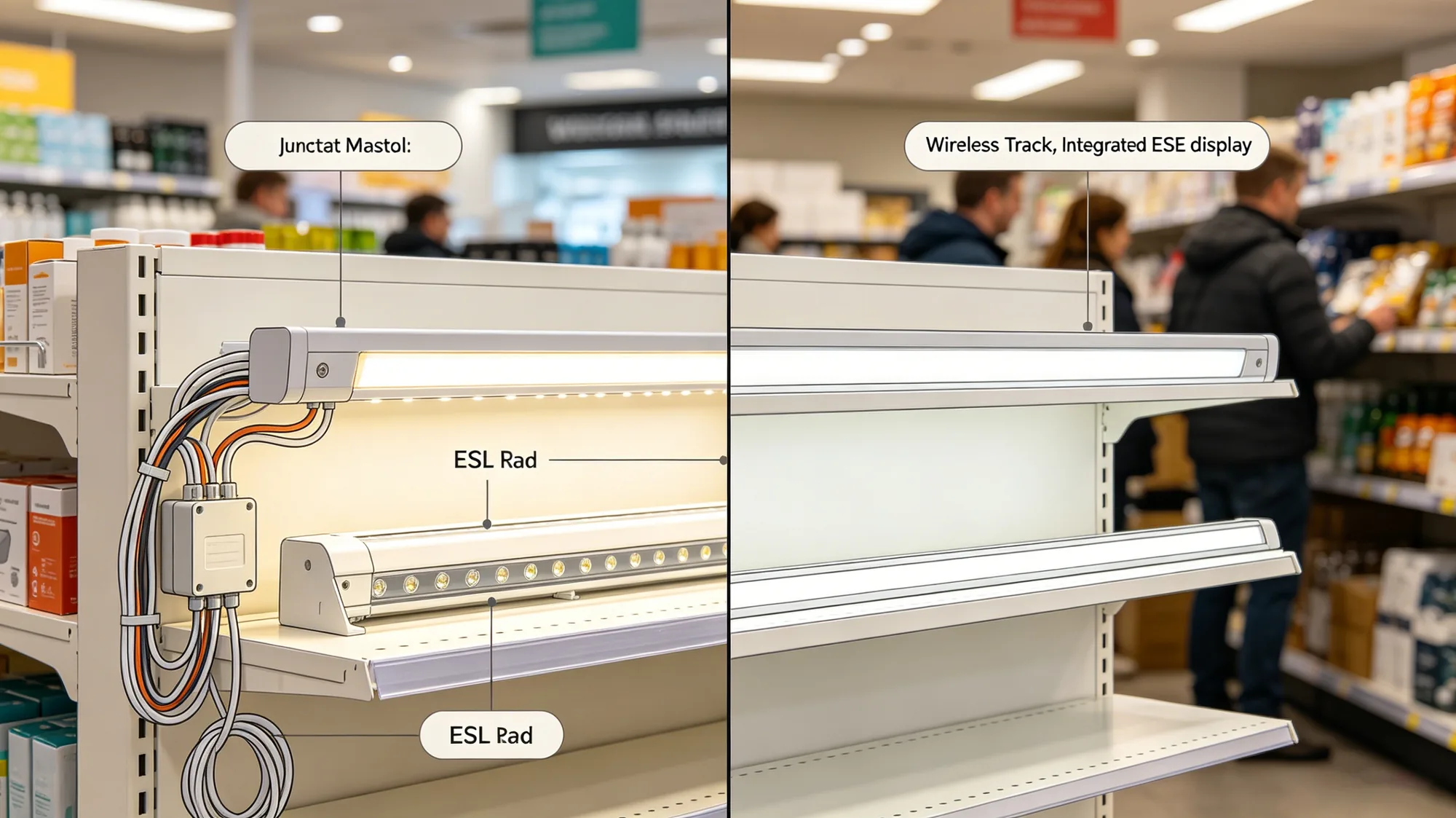
Retailers typically procure lighting and digital signage through separate channels. Lighting goes to the construction team. ESL or digital screens go to the IT or operations team. The two systems are installed in different project phases, by different contractors, with different timelines. This separation creates three cost layers that no single budget owner sees:
- Duplicate ceiling and shelf work. Scaffolding, aisle closures, and staff disruption happen twice.
- Incompatible mounting. Lighting tracks and ESL rails compete for the same shelf real estate.
- Vendor fragmentation. Two warranties, two support contacts, two sets of spare parts.
What “Integrated Deployment” Actually Looks Like
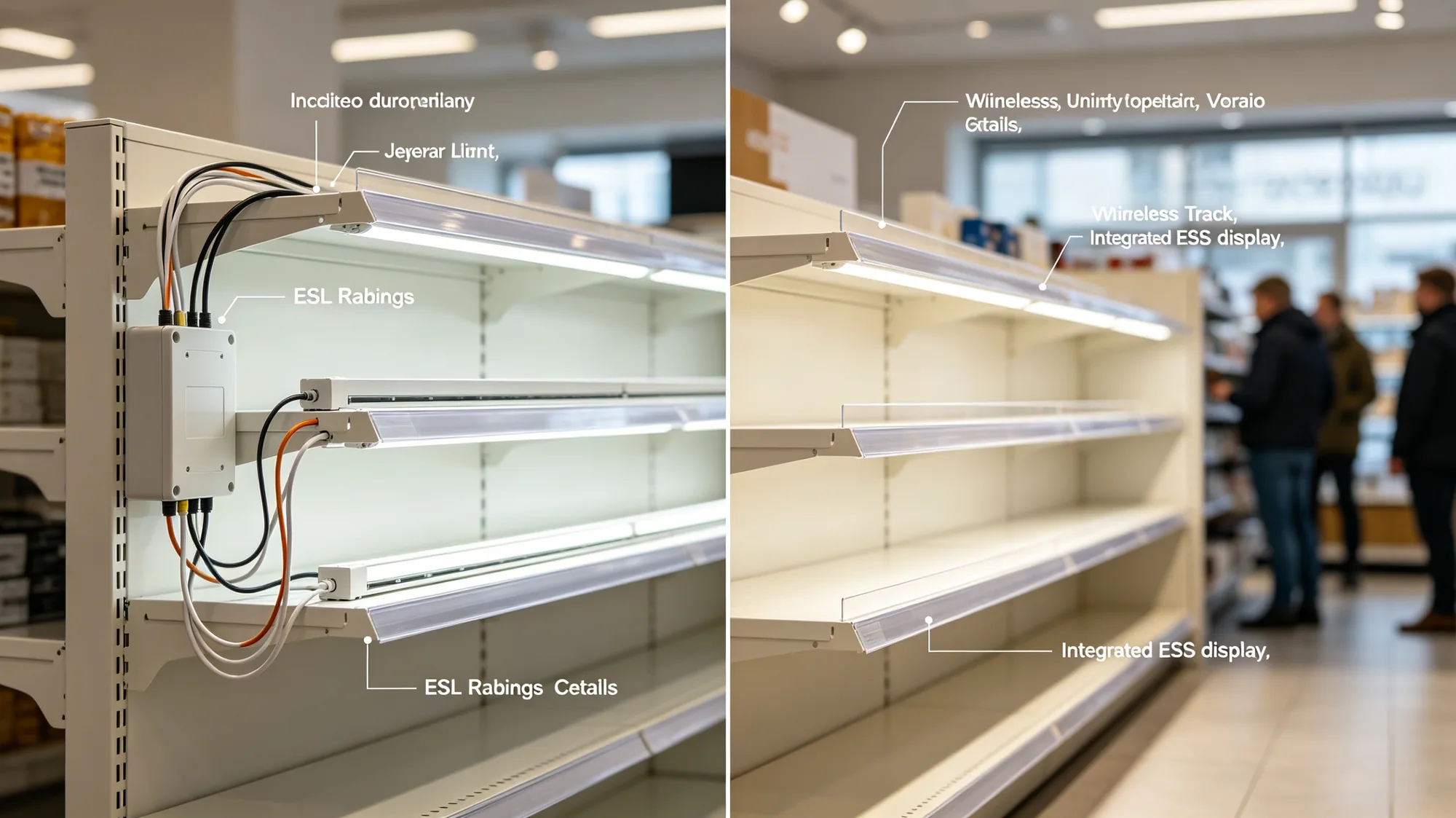
An integrated approach means one infrastructure layer serves both lighting and digital displays. At ARMOR, this is achieved through a unified shelf profile that combines:
- Wireless conductive power track (48V DC) for LED lighting
- Integrated data rail for ESL communication and digital signage
- Shared mounting channel compatible with both lamp adapters and display brackets
The result: one installation, one vendor, one timeline, one warranty.
Where the 30% Savings Come From
| Cost Category | Separate Deployment | Integrated Deployment | Savings |
|---|---|---|---|
| Installation labor | 2 contractor teams, 2 mobilizations | 1 team, 1 visit | 40–50% |
| Scaffolding and lift rental | 2 rental periods | 1 rental period | 50% |
| Aisle closure and lost sales | 2 disruption windows | 1 disruption window | 50% |
| Project management | 2 vendors to coordinate | 1 vendor, 1 PM | 30% |
| Spare parts inventory | 2 SKU pools | 1 unified pool | 25% |
| Blended typical saving | 25–35% |
A Real-World Scenario: 500m² Supermarket Renovation
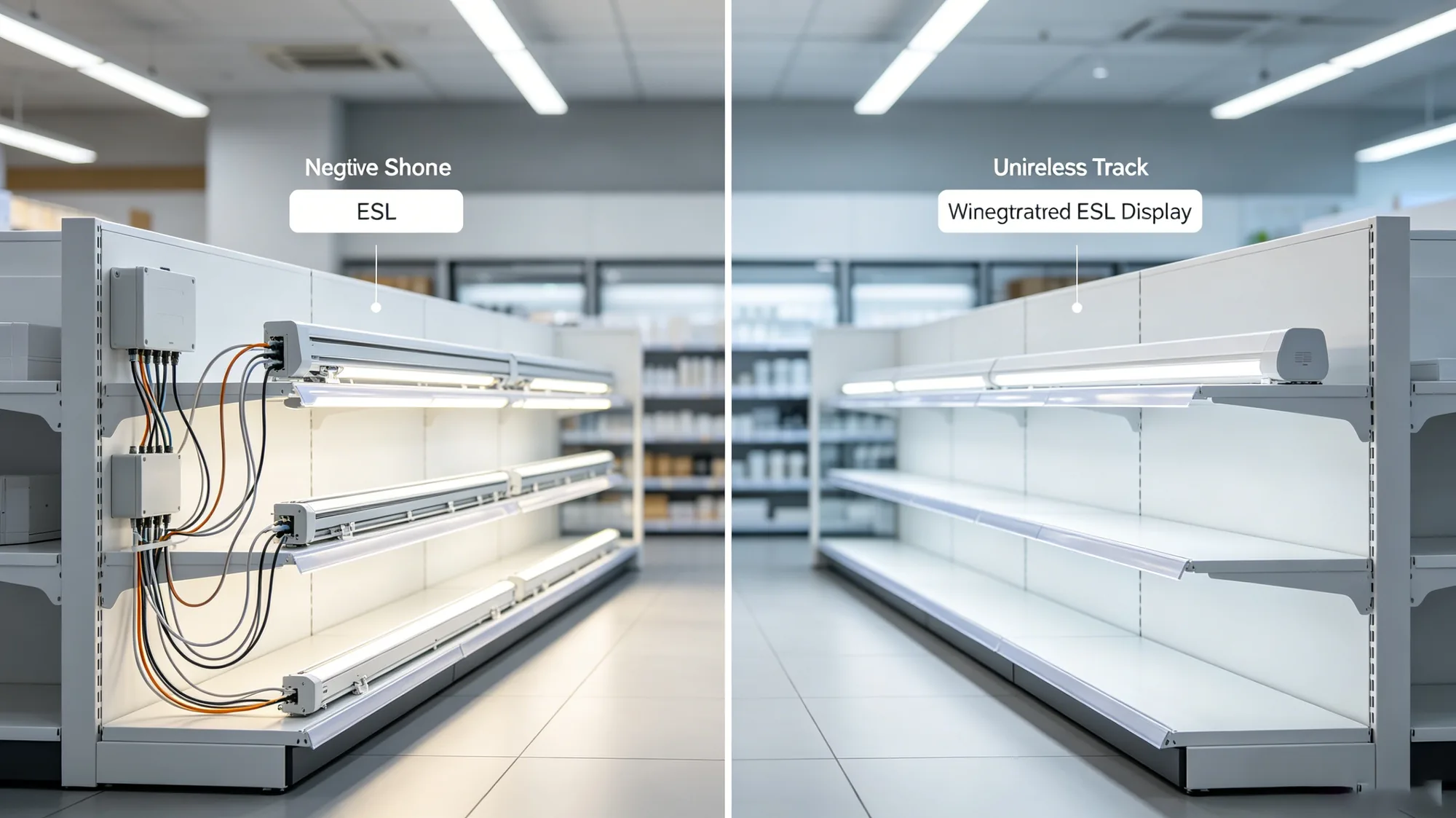
Separate deployment:
- Lighting installation: 5 days, $18,000
- ESL installation: 3 days, $8,000
- Overlap disruption (aisle closures): 8 days total
- Project management overhead: 2 vendors, 6 weeks coordination
- Total infrastructure cost: ~$32,000
Integrated deployment:
- Combined installation: 5 days, $22,000
- Aisle closures: 5 days
- Project management: 1 vendor, 4 weeks coordination
- Total infrastructure cost: ~$22,000
Net saving: $10,000 (31%) plus 2 weeks faster reopening. 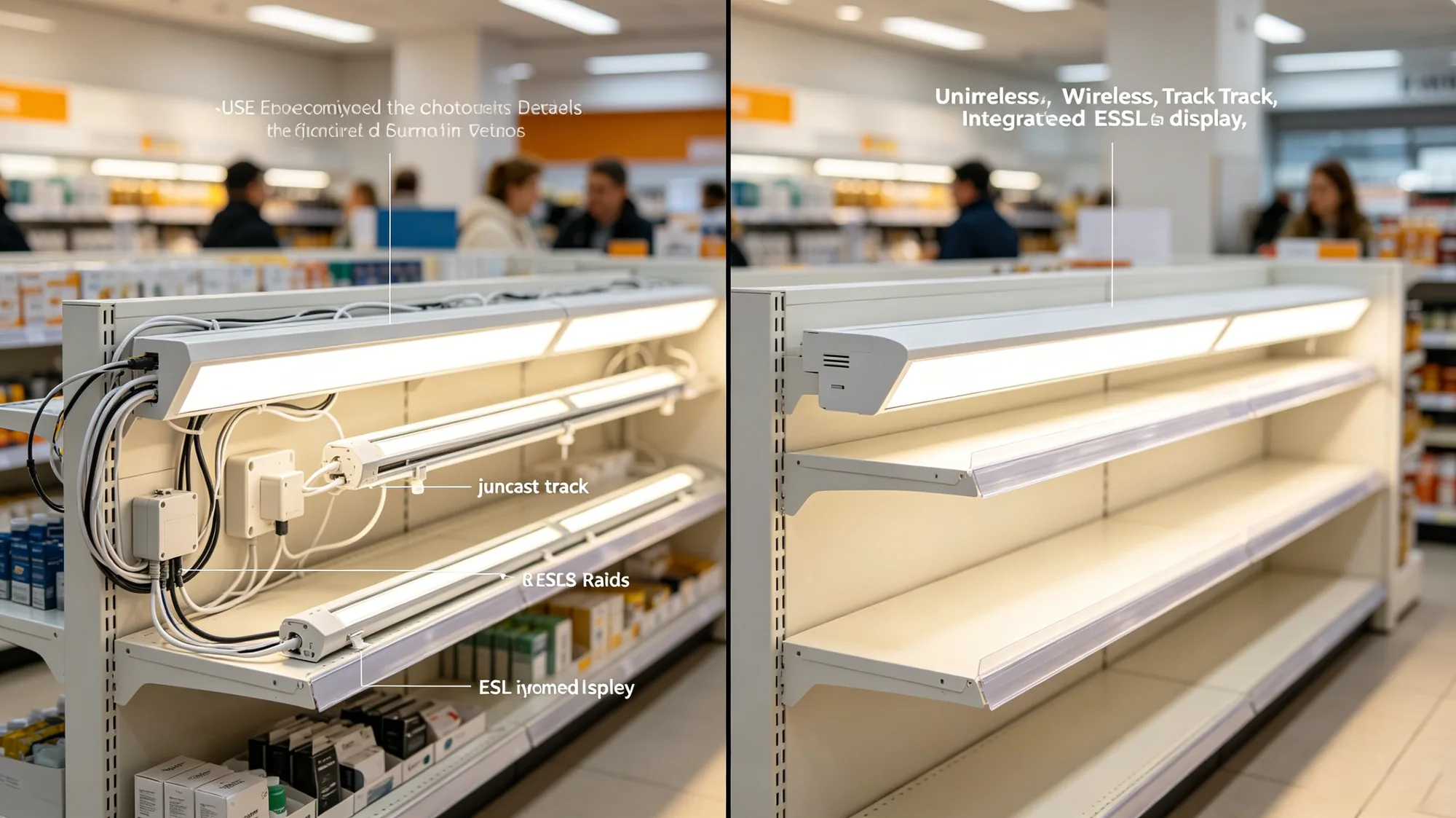
Beyond First Cost: Operational Synergies
The integration pays dividends after opening day. Unified power management. Both lighting and ESL draw from the same 48V DC bus. Power monitoring, fault detection, and energy reporting happen through one dashboard. Coordinated content. Promotional lighting — a spotlight on a featured product — can trigger automatically when the ESL label switches to “SALE” pricing. The two systems communicate through a shared API layer. Single point of accountability. When a shelf zone goes dark or a display fails, one vendor resolves both. No finger-pointing between lighting contractor and IT integrator.
What to Specify for Integrated Projects
If evaluating integrated deployment, verify these points with suppliers:
| Requirement | Verification |
|---|---|
| Shared physical profile | Can lighting and ESL mount to the same rail? |
| Electrical isolation | Is 48V power safely separated from data signaling? |
| Load capacity | Can the track handle full lighting load plus ESL hub power? |
| Certification scope | Are both lighting and ESL under the same safety certification? |
| API unification | Can lighting scenes and ESL content be triggered from one system? |
| Warranty coverage | Is there a single warranty for the integrated system? |
ARMOR’s integrated shelf profile is CE-certified as a complete system, supports 300W per 3-meter section, and provides a unified REST API for both lighting control and ESL content management.
Conclusion
Retail infrastructure is finally moving from siloed systems to unified platforms. For store renovations, new builds, or retrofit programs, integrating lighting and ESL deployment is not just a cost reduction. It is an operational simplification that pays back for years. The 30% saving on installation is the headline. The real value is what comes after: one vendor relationship, one management interface, and one less thing to coordinate.
Related Product Families
- Electronic Shelf Labels
Browse ARMOR electronic shelf label products for dynamic pricing and product information at retail shelves.
Retail Digital → - Shelf & Cabinet Lighting
Browse ARMOR shelf and cabinet lighting products for retail fixtures, gondolas, showcases, and cabinets.
Retail Lighting →
Planning a Retail Digital Project?
Need help applying this digital shelf approach to your project?
If you're evaluating ESL, digital shelf, or retail digital systems for a project, tell us what you're working on.
Related to what you're reading
Why Integrated Lighting and ESL Deployment Cuts Store Renovation Costs by 30%
Related Articles
View All Articles »
When Does an LCD Shelf Label Earn Its Cost in a Retail Media Program?
An LCD shelf label earns its higher cost in a retail media program only where the screen can be sold as media: a zone with a funded campaign calendar, continuous power, and proof-of-play expectations. Where the job is mainly accurate pricing across dense SKU a